Monday, February 18, 2019

Thursday, December 20, 2018
"Here I Raise My Ebenezer..."
The two previous posts, "The Waiting Room of Mercy" and "The Rhythm" are the context of these thoughts.
Christmas Break 2018 officially begins at the end of tonight's concert, but a different cause for celebration has been in the air all week. While the bazaar with all its secret shopping and gift wrapping was happening in the main foyer, a quieter kind of enterprise was happening in the preschool room where the Senior Worldview Class had temporarily set up shop.

It was a grave situation. Read Wednesday's reports on Luke here:
Grand
Haven Tribune: A second chance at life and Thursday's Update
Mlive: Michiganteen who'died on court' and saved by AED surprises teammates and Thursday's update.
WZZM13: Calvary Christian Schools Coach Uses AED to Save Basketball Player's Life
So what is the best use of instructional time on the heels of such an ordeal? Even though miraculously good news had come sooner than expected, their teacher, Mrs. Julie Kapanka, knew that a hands-on diversion would be better than jumping right back into last week's lesson plans.WZZM13: Calvary Christian Schools Coach Uses AED to Save Basketball Player's Life

"We're going to make something that will remind you of what God did this Christmas. Years from now, you'll see this and know it's not just an ornament. You'll remember the miracle of Luke 2 and Luke, too."


Mrs. K did not use the word "Ebenezer," but when she heard her explain the project to me I immediately thought of that word.
 The name Ebenezer seems inseperable from Dicken's A Christmas Carol, and because of the character Ebenezer Scrooge, it often has a negative connotation. The word Ebenezer, however, is a solid stand-alone noun. It refers to a physical reminder memorializing when God divinely intervened in response to "cries" of those who call Him Lord.
The first use of Ebenezer is I Samuel 7:12, and in that case the reminder was a tall boulder. I like the way The Message puts it:
"He named it 'Ebenezer' (Rock of Help), saying, “This marks the place where God helped us.”
Keep in mind that in I Samuel 4, Israel had suffered horrible defeats and the loss of 34,000 men at that same place, and they bemoaned the fact that God abandoned them. Then in this third battle, with their backs against the wall, they begged Samuel to cry out non-stop, and God directly intervened. Does this mean that when bad things happen, God is gone and when good things happen He shows up? Or could it mean that He is not bound by human rationale. He writes the lesson plans and determines whether teachable moments come through victory or defeat; mercy or justice; healing or heartbreak.
In our episode last week, when the commotion and phone calls began last Thursday around 4:00, I have never known of so many people praying so fervently within minutes. The first responders were super fast, but literally hundreds if not thousands of people in inter-linking prayer chains across the country were immediately crying out, including the seniors in these pictures.
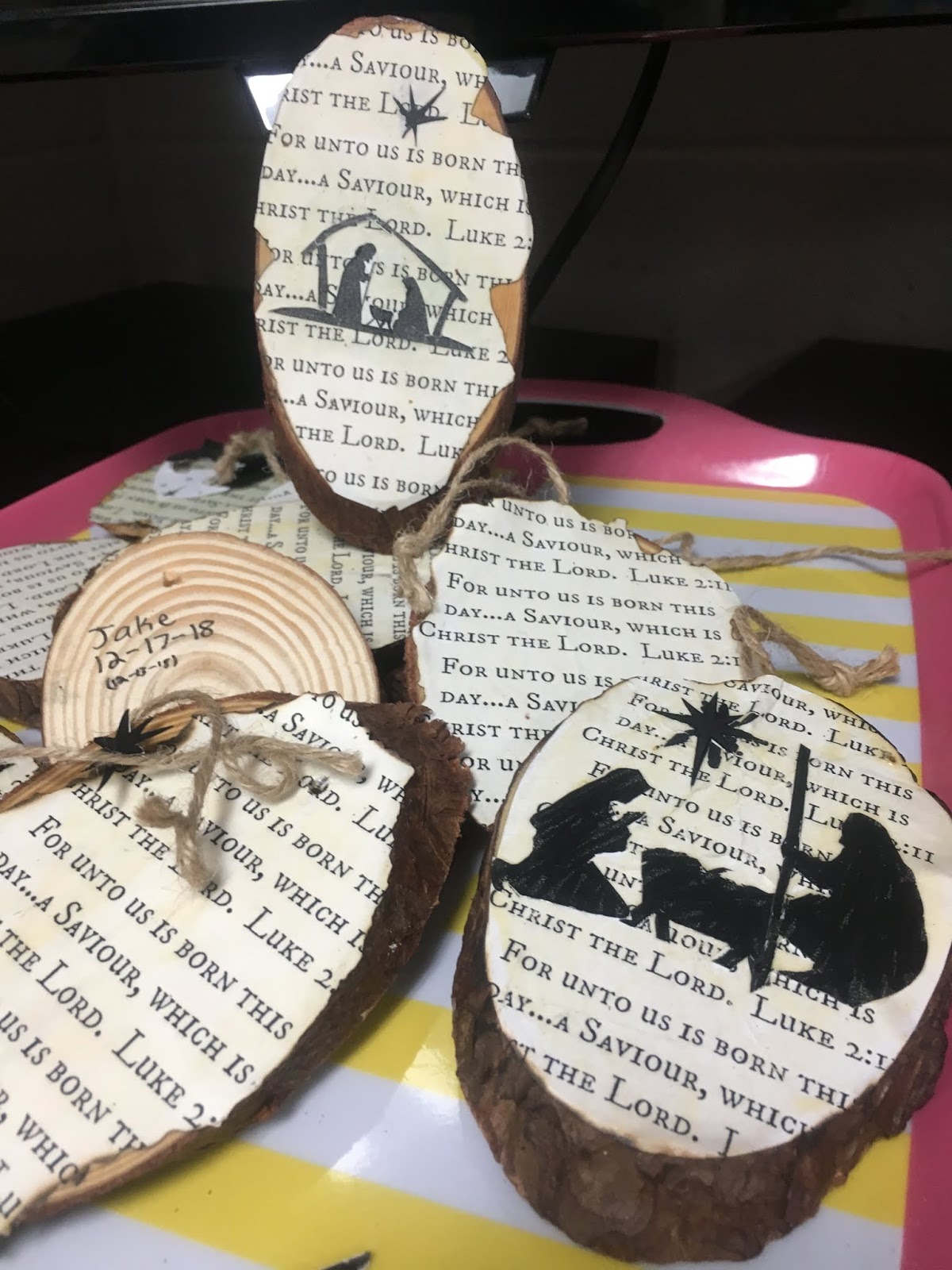 It is in that sense, that the ornaments the seniors made in Worldview class are little "Ebenezers" that will help them remember what happened this week for years to come. Don't get me wrong--I know we shouldn't dwell on the past beyond the extent to which it makes us more effective in the present. Tragic events are not easily forgotten, but ironically, when such events take a miraculous turn like the victory in I Samuel 7, they can fade as things return to normal. For that reason, all those who carry on with life need Ebenezers or reminders like tiny-stoned wedding rings, commemorative plaques, broken bread, rainbows of promise, and yes, even ornaments depicting the nativity of Luke 2.
There is another place where we hear the word Ebenezer besides Dickens and the Books of Samuel. It's in the great old hymn "Come Thou Fount". Those words were penned by a 22-year-old Robert Robinson in the year 1757. You remember the line in the second stanza, "Here I raise my Ebenezer; hither by thy help I'm come; and I hope, by thy good pleasure, safely to arrive at home."
I began writing this post at 4:30AM. I was alone in my living room. Reading on-line news articles about Luke's incident and thinking about the short attention span we humans have. Why did Samuel raise a stone to remind them how the Lord helped them win the battle? Because he knew they were humans and tend to forget, as the old gospel song says.
It was for these reasons that I woke at 4:30AM to find the word Ebenezer word in a 260-year-old hymn written by a young man not much older than Luke, but when I read the lyrics a few other lines brought tears to my eyes in light of this week's events.
1. Come, thou Fount of every blessing,
tune my heart to sing thy grace;
streams of mercy, never ceasing,
call for songs of loudest praise.
Teach me some melodious sonnet,
sung by flaming tongues above.
Praise the mount! I'm fixed upon it,
mount of thy redeeming love.
2. Here I raise my Ebenezer;
hither by thy help I'm come; [Hither means, "To this place"]
and I hope, by thy good pleasure,

Jesus sought me when a stranger,
wandering from the fold of God;
he, to rescue me from danger,
interposed his precious blood.
3. O to grace how great a debtor
daily I'm constrained to be!
Let thy goodness, like a fetter,
bind my wandering heart to thee.
Prone to wander, Lord, I feel it,
prone to leave the God I love;
here's my heart, O take and seal it,
seal it for thy courts above.
[Press arrow to hear "Come Thou Fount" by Chris Rice]
I am pleased to introduce you to a new blog that Luke's mom and CCS Librarian, Sam Anhalt, just began yesterday.
Sam's blog is called, "Crazy Might Work" at this link.
I know it will become a comforting place to stay in touch with this situation so we can better pray for this dear family as they work through the ache of joy that comes from such experiences.
Merry Christmas to you all!
Sunday, December 16, 2018
The Waiting Room of Mercy
The waiting room of Mercy
is a place with no address
where loved ones mix with strangers
and faint smiles mix with stress…
where whispers catch attention
and laughter goes unheard
as stares fix on a distant door
awaiting some new word.
The chairs in Mercy's waiting room
hold hope and hints of strife.
The time is measured not by clocks
but subtle rhythms of life…
like blinks held shut and breaths held in
and sighs in sync let go...
or pacing feet past eyes that meet
while scanning to and fro
in search of strength from "they that wait"
for hours turned to days…
till, if God wills, all trembling lips
give way to pent-up praise.
©Tom Kapanka 12-16-2018


Mlive:
is a place with no address
where loved ones mix with strangers
and faint smiles mix with stress…
where whispers catch attention
and laughter goes unheard
as stares fix on a distant door
awaiting some new word.
The chairs in Mercy's waiting room
hold hope and hints of strife.
The time is measured not by clocks
but subtle rhythms of life…
like blinks held shut and breaths held in
and sighs in sync let go...
or pacing feet past eyes that meet
while scanning to and fro
in search of strength from "they that wait"
for hours turned to days…
till, if God wills, all trembling lips
give way to pent-up praise.
©Tom Kapanka 12-16-2018


These pictures were taken in place called Mercy Hospital, street address: 1500 E Sherman Blvd., but the above lines are also about a more abstract place that can be called "The Waiting Room of Mercy," a waiting room that calls us all at different times in life and in any place where we learn from "they that wait upon the Lord" in prayer and supplication.
The opening lines of the post were prompted by some hours I spent at Mercy Hospital this past Thursday night, awaiting the news regarding a senior at CCS who, in the peak of health and fitness, suffered a cardiac arrest in our school gym during a routine basketball practice. His teammates were the first to gather 'round him. They are seated in some of the pictures above.
Thanks to his coach, the AED in our gymnasium, and the immediate arrival of our local first responders, this story has a very miraculous outcome, but that was unknown at the time of these photos.
The last photo is the moment that the boy's father first saw his dear friend, his son's coach, whose calm and trained response saved his son's life. I will post a video link to the good news that came over the weekend. In the meantime, here are two initial news articles from Friday and Saturday.
Click on title below:
Click on title below:
Mlive:
AED and quick thinking by coach credited with saving West Michigan teen’s life
Grand Haven Tribune
Grand Haven Tribune
Coach saves player who collapses at practice
Do you want to hear something that has brought comfort over these past few days? The student in this story is a leader on our school praise team. With him, the student body has sung a song called "I will follow" by Jon Guerra (a friend of CCS) countless times. The praise team sang that song Thursday morning in chapel, not knowing what the afternoon held.
Just three days after that announcement in church, WZZM 13 ran this story on the 6:00 News.
Calvary Christian School coach uses AED to save basketball player's life
"Even in the Storms I'll Follow You..."
In the post above, someone left a comment that brought this thought to mind... (post-time-stamped to sequentially follow)
The student who is the unnamed subject of that post is a key leader in our praise and worship rotation for chapels. There was a time when he was reluctant to sing in public. In fact, we had to coax him to join two years ago. That's hard to imagine now. I mention this only to say that Luke and his fellow praise and worship leaders have led our students in singing "I Will Follow" countless times at Fall Retreat and chapels, and the special K-12 praise and worship times we do at the end of each quarter.
This song was sung by the praise team the morning of the incident. The first clip provides the lyrics; the second clip is more reflective of our student body singing along.
The student who is the unnamed subject of that post is a key leader in our praise and worship rotation for chapels. There was a time when he was reluctant to sing in public. In fact, we had to coax him to join two years ago. That's hard to imagine now. I mention this only to say that Luke and his fellow praise and worship leaders have led our students in singing "I Will Follow" countless times at Fall Retreat and chapels, and the special K-12 praise and worship times we do at the end of each quarter.
This song was sung by the praise team the morning of the incident. The first clip provides the lyrics; the second clip is more reflective of our student body singing along.
(Incidentally, Jon Guerra is married to Valarie Strattan, CCS Class of 2003. Together they are "Praytell," and they were in town performing at the Beardsley Theater the day this happened. Here is one of the songs from their Christmas concert that night.)
Saturday, December 15, 2018
The Rhythm
The December 16 post above came to me Sunday morning before church For some people, writing is a cathartic process. Sometimes things I write are never seen again. Sometimes they make even more sense years later. Other times, old drafts have subconscious influence on new thoughts. This happened over and over again this weekend. "The Rhythm" was first posted in 2007 and explained here in 2009. "The Waiting Room of Mercy," echoed lines of a post by that name in 2005. At any rate, the following, though mostly written a decade ago, is a fitting companion piece for this week's events. [The post date was changed to appear below the two posts above it.]
The Rhythm
Life is danced to rhythms
we soon forget are there.
The blink of eyes, the beat of hearts,
the breath and sigh of air
 are lost to cycles of the sun
and pass with little care.
They slip our mind as measures
in time until we're unaware
we wake t’thm, walk t’thm,
work t’thm, talk t’thm,
laugh t’thm, cry t’thm,
live t’thm... die t’thm.
It becomes a most ungraceful dance
when we ignore the Hand that grants
the Grace and gently taps... the rhythm.
© Copyright 2007, TK, Patterns of Ink
 The moment you were born, the rhythm of breathing in and out began.
Try this with me. Hold your breath for 30 seconds as you read this paragraph. Ready? Start.You are suspending a rhythm of life. If you do this for too long, your brain will begin screaming, “Hey, silly, let your body do what God made it to do. Let it breathe until it’s time not to.” Still holding?.... Now exhale and breathe in again. Ahhh... isn't it amazing?
.
Earth’s air outside our bodies has just the right amount of oxygen; our lungs have just the right design to take that oxygen from the air and pass it along to our blood; the heart sends the oxygenated blood coursing through our veins to millions of cells and muscles, including those that power the billows of our lungs that breathe in and out the air. Just as our brain whispered for breath as we read that last paragraph, our body itself cries out for air, "Keep breathing, lungs! Keep beating, heart! Your rhythms of life sustain me!"
This is just a hint of what the Psalmist meant when he said, we are “fearfully and wonderfully made”? It is frightening. It is wonderful.
We cannot bank breaths. It's strictly an "in and out" account. The word "inspire" literally means "to breathe into." When doing something creative, we sometimes say this "inspired" me, meaning "this gave life to the idea." When our last breath of life is let go, and the opposite of inspire happens: we expire (we literally ex-spire, breathe out). But more than that happens. The “spire” part of both words is the root of the word spirit. The spirit leaves the body soon after that last breath. This may seem too obvious for words, but events of recent days make it feel profound if not surreal. Those events prompted me to share some of these thoughts with our 6-12 students last Friday morning.
Our beating heart and breathing in and out measure time more surely than a clock, for they measure our time.
Is that what is meant by “fearfully…made”—that sometimes we are afraid the rhythm will stop? Maybe. It does happen. Scripture tells us life is a vapor, and its brevity is not something we like to dwell on. For that reason, I prefer to think "fearfully made" means complexity beyond comprehension. I touched on this in a poem called WONDER IS. The truth is we wonder about far more than we know when it comes to the miracle of life.
.
One of the comments left in the Mlive article in the December 16 post came from a reader who could not understand why God and not science was getting credit for what many were calling a miracle. I understand that modern man is prone to give science the credit for such events. After all, science figured out the mechanics of how organs like the heart and lungs function, and man did invent the AED machine that provides the electrical impulse needed for resuscitation, but prayer cries out to the One who first put that impulse in the first heart. Prayer reaches beyond how things work and gives credit to the Creator who knows why they work (i.e. the reason for life) to begin with.
In that sense, the "fear" of being wonderfully made is the same fear as in "The fear of the Lord is the beginning of wisdom." [Proverbs 9:10]
Those who reject God or relegate him to some far-off "force" seem to fear the fearful miracle... They fear of the implications of being "wonderfully made." It's not the wonder that frightens them... it's the word made. That word implies a Creator. What if the breath of life is inseparable from the breath of God? If so, believers and agnostics alike face two choices: to believe that breath and the God who made it have purpose. Or to pretend... that LIFE JUST HAPPENED.
If everything we see just happened--a galactic box of BBs spilled--then we owe nothing to anyone. We're accountable to no one. We can live and let live. "Eat, drink and be merry, for tomorrow we die." The problem with pretending the intricate design and delicate rhythms of life just happened is that we lose any hope of relationship with God, time and eternity. We begin to think life is all about us and our fleeting existence. As Peggy Lee's hit song in 1969 put it...
The following song was added in April, 2023, as another example remembering “the hand that grants the grace and gently taps the rhythm.”
The Rhythm
Life is danced to rhythms
we soon forget are there.
The blink of eyes, the beat of hearts,
the breath and sigh of air
are lost to cycles of the sunand pass with little care.
They slip our mind as measures
in time until we're unaware
we wake t’thm, walk t’thm,
work t’thm, talk t’thm,
laugh t’thm, cry t’thm,
live t’thm... die t’thm.
It becomes a most ungraceful dance
when we ignore the Hand that grants
the Grace and gently taps... the rhythm.
© Copyright 2007, TK, Patterns of Ink
 The moment you were born, the rhythm of breathing in and out began.
Try this with me. Hold your breath for 30 seconds as you read this paragraph. Ready? Start.You are suspending a rhythm of life. If you do this for too long, your brain will begin screaming, “Hey, silly, let your body do what God made it to do. Let it breathe until it’s time not to.” Still holding?.... Now exhale and breathe in again. Ahhh... isn't it amazing?

.
Earth’s air outside our bodies has just the right amount of oxygen; our lungs have just the right design to take that oxygen from the air and pass it along to our blood; the heart sends the oxygenated blood coursing through our veins to millions of cells and muscles, including those that power the billows of our lungs that breathe in and out the air. Just as our brain whispered for breath as we read that last paragraph, our body itself cries out for air, "Keep breathing, lungs! Keep beating, heart! Your rhythms of life sustain me!"


This is just a hint of what the Psalmist meant when he said, we are “fearfully and wonderfully made”? It is frightening. It is wonderful.
We cannot bank breaths. It's strictly an "in and out" account. The word "inspire" literally means "to breathe into." When doing something creative, we sometimes say this "inspired" me, meaning "this gave life to the idea." When our last breath of life is let go, and the opposite of inspire happens: we expire (we literally ex-spire, breathe out). But more than that happens. The “spire” part of both words is the root of the word spirit. The spirit leaves the body soon after that last breath. This may seem too obvious for words, but events of recent days make it feel profound if not surreal. Those events prompted me to share some of these thoughts with our 6-12 students last Friday morning.

Our beating heart and breathing in and out measure time more surely than a clock, for they measure our time.
Is that what is meant by “fearfully…made”—that sometimes we are afraid the rhythm will stop? Maybe. It does happen. Scripture tells us life is a vapor, and its brevity is not something we like to dwell on. For that reason, I prefer to think "fearfully made" means complexity beyond comprehension. I touched on this in a poem called WONDER IS. The truth is we wonder about far more than we know when it comes to the miracle of life.
.
One of the comments left in the Mlive article in the December 16 post came from a reader who could not understand why God and not science was getting credit for what many were calling a miracle. I understand that modern man is prone to give science the credit for such events. After all, science figured out the mechanics of how organs like the heart and lungs function, and man did invent the AED machine that provides the electrical impulse needed for resuscitation, but prayer cries out to the One who first put that impulse in the first heart. Prayer reaches beyond how things work and gives credit to the Creator who knows why they work (i.e. the reason for life) to begin with.
In that sense, the "fear" of being wonderfully made is the same fear as in "The fear of the Lord is the beginning of wisdom." [Proverbs 9:10]
Those who reject God or relegate him to some far-off "force" seem to fear the fearful miracle... They fear of the implications of being "wonderfully made." It's not the wonder that frightens them... it's the word made. That word implies a Creator. What if the breath of life is inseparable from the breath of God? If so, believers and agnostics alike face two choices: to believe that breath and the God who made it have purpose. Or to pretend... that LIFE JUST HAPPENED.
If everything we see just happened--a galactic box of BBs spilled--then we owe nothing to anyone. We're accountable to no one. We can live and let live. "Eat, drink and be merry, for tomorrow we die." The problem with pretending the intricate design and delicate rhythms of life just happened is that we lose any hope of relationship with God, time and eternity. We begin to think life is all about us and our fleeting existence. As Peggy Lee's hit song in 1969 put it...
"...When that final moment comes
and I'm breathing my last breath,
I'll be saying to myself:
Is that all there is, is that all there is?
If that's all there is, my friends,
then let's keep dancing.
Let's break out the booze
Let's break out the booze
and have a ball... If that's all...there is"
[Press arrow to play]
[Press arrow to play]
That song depicts the last lines of the poem at the top of this post. It is a "... most ungraceful dance [that] ignores the Hand that grants the Grace and gently taps... the rhythm." As for me and my house [and our school], "[We] will praise Thee for [we are] fearfully and wonderfully made" That same psalmist added in the very last verse of the same Psalm:
.
Friday, December 7, 2018
Sometimes Our Roots Hold up Our Arms

I've written about roots before in reference to my father. More recently, I've written about "Roots around Rock" in reference to the importance holding to Biblical ideals in a less-than ideal world.
Sometimes, however, roots serve a different function. Sometimes or roots literally help us bear one another's burdens. The image of a banyan tree comes to mind. I have walked among banyan trees in Thailand and Hawaii and they are quite unlike anything we see in Michigan.
This is my 38th consecutive year in full-time K-12 Christian education. The older I get, the more life feels like that, like a banyan tree... it gets harder to tell where our roots end and our branches begin.
Beyond the curriculum and classroom objectives is the equally important goal of building a community of "family trees." Christian schools typically draw from many different neighborhoods, churches, and towns, so the "community" I refer to is based less on geography than common ground. Our students may not walk the same sidewalks to get to school (as my friends and I did in my childhood), but they do walk the same path and that path is illuminated by the same lamp. Going back to the original metaphor, our family trees are rooted in the same soil.
As our school families grow together, let us draw strength from those who serve by our side. May there be joy in knowing we are not alone, and when we do feel alone, or when we feel overwhelmed or short-handed, may we find strength in knowing our roots can hold up our arms.
 Exodus 17:11-12 11 Whenever Moses held up his hand, Israel prevailed, and whenever he lowered his hand, Amalek prevailed. 12 But Moses' hands grew weary, so they took a stone and put it under him, and he sat on it, while Aaron and Hur held up his hands, one on one side, and the other on the other side. So his hands were steady until the going down of the sun.
Sunday, December 2, 2018
Why this blog is called "To Begin With..."
This week has brought an unusual amount of traffic to this site and some have asked why I chose this name for my Administrator's Blog.
Here is the inaugural post from July 29, 2011...
There is a great courtroom scene in the film classic, To Kill a Mockingbird, in which Atticus Finch (Gregory Peck) opens his closing argument by saying, “To begin with, this case should never have come to trial. The state has not produced one iota of medical evidence that the crime Tom Robinson is charged with ever took place....”
Those three words, “to begin with,” carry weight. They declare a foundational premise. They imply that we must first understand the beginning or what follows will not make sense. Worse yet, if we ignore the premise we will embrace an alternate "sense" which will lead to nonsense, and nonsense has victims. (I Corinthians 1:18-20)
In the case of the above courtroom scene, Tom Robinson falls victim to the nonsense that comes from ignoring the words “to begin with.”
The Bible opens with three similar words: “In the beginning, God created the heavens and the earth”
Genesis 1:1 is primarily a chronological statement--as if to say, “Step One: God built a stage before adding scenery, lighting, characters and plot.”
 Beyond chronology, however, the opening verse of Genesis implies a premise, a foundational truth supporting all other truth. It not only declares the when of creation, it also declares the who, as if to say: “To begin with, [or “understand this first,” "most importantly,” “make no mistake,”…] it was the Creator God who set all things in motion. He built the stage, placed the scenery, set the lights, cast the characters, and wrote the plot. He alone is the producer and director of everything that happens on the stage. Remember this premise, and the plot will make sense; ignore it, and fall victim to endless variations of nonsense before all is said and done.”
This blog is called “To Begin With” because the essays, anecdotes, poems, etc. posted here each month or so will reflect the foundational worldview of Christian education. I hope these gathering thoughts will illustrate that the partnership between homes, churches, and the Christian school is the ideal way for instruction to begin and that a foundational K-12 education sets the stage for God-honoring lives of service. In other words...
To begin with, Christian education provides a foundation to begin with...
Check here every month or so for a new post, and feel free to join in the dialogue if any in the comment section.
Tom Kapanka
CCS Administrator
Here is the inaugural post from July 29, 2011...
There is a great courtroom scene in the film classic, To Kill a Mockingbird, in which Atticus Finch (Gregory Peck) opens his closing argument by saying, “To begin with, this case should never have come to trial. The state has not produced one iota of medical evidence that the crime Tom Robinson is charged with ever took place....”
Those three words, “to begin with,” carry weight. They declare a foundational premise. They imply that we must first understand the beginning or what follows will not make sense. Worse yet, if we ignore the premise we will embrace an alternate "sense" which will lead to nonsense, and nonsense has victims. (I Corinthians 1:18-20)
In the case of the above courtroom scene, Tom Robinson falls victim to the nonsense that comes from ignoring the words “to begin with.”
Genesis 1:1 is primarily a chronological statement--as if to say, “Step One: God built a stage before adding scenery, lighting, characters and plot.”

This blog is called “To Begin With” because the essays, anecdotes, poems, etc. posted here each month or so will reflect the foundational worldview of Christian education. I hope these gathering thoughts will illustrate that the partnership between homes, churches, and the Christian school is the ideal way for instruction to begin and that a foundational K-12 education sets the stage for God-honoring lives of service. In other words...
To begin with, Christian education provides a foundation to begin with...
Check here every month or so for a new post, and feel free to join in the dialogue if any in the comment section.
Tom Kapanka
CCS Administrator
Thursday, February 22, 2018
CCS: Now More Than Ever!
I've not written much lately about my trip to China in the 2014-2015 school year. The geopolitical shifts we have witnessed since that trip have tabled much of the openness and "red carpet" treatment we were shown three years ago. Don't get me wrong, I am very willing to be in a "wait and see" mode regarding these geopolitical shifts, but I think of China often, and we do keep in touch with some of our educational friends there.
I came across this short video commentary from a professor at Harvard Business School, and I couldn't help but think of the many similar conversations I had with Chinese educators and with many of our Chinese friends here in the states since that time.
It is often those who come from a culture where religion is very stifled (if not snuffed out) who are most able to see the reality of a different culture. What is frightening about this video clip (and the observation of a visiting Chinese scholar), is that the foundation he refers to is crumbling.
CCS is committed to fortifying that foundation one student at a time.The video clip below speaks of the general need for accountability to God in order for our system of government to work. We stress this in our booklet entitled "Roots around Rock; Teaching Toward Ideals in a Less Than Ideal World."
Use of this video is not an endorsement of all views of speaker.
I came across this short video commentary from a professor at Harvard Business School, and I couldn't help but think of the many similar conversations I had with Chinese educators and with many of our Chinese friends here in the states since that time.
It is often those who come from a culture where religion is very stifled (if not snuffed out) who are most able to see the reality of a different culture. What is frightening about this video clip (and the observation of a visiting Chinese scholar), is that the foundation he refers to is crumbling.
CCS is committed to fortifying that foundation one student at a time.The video clip below speaks of the general need for accountability to God in order for our system of government to work. We stress this in our booklet entitled "Roots around Rock; Teaching Toward Ideals in a Less Than Ideal World."
"The process of teaching ideals begins with an understanding of human nature and its resistance to external expectations. At the heart of all formative ideals is a clear sense of accountability. In William Golding’s Lord of the Flies, the question of whether man is basically “good” or “bad” is vividly answered in the undeniable reality that human nature is only as good as man’s sense that an “authority” exists to which he will someday answer for his actions. In other words, the ability to exercise “good judgment” individually requires acceptance of the reality of judgment/accountability and the authorship/authority of behavioral ideals beyond one’s self. As Golding’s shocking tale reveals, if shared ideals erode over time, cycles of natural human behavior become apparent as shared, agreed-upon moral ideals give way to everyone doing what is right in their own eyes...."
Thursday, December 14, 2017
Dropping the Blanket at Christmas Time...
[Originally posted December, 2017]
"Isn't there anyone who knows what Christmas is all about?"
On December 9, 1965, I was nine years old. That Thursday night, my family sat in our little living
 room in front of an old Admiral black-and-white TV (like the one in this photo). With a big bowl of popcorn to share, the six of us were all snuggled up to watch a Christmas special. (The show was in "color"--a fact we would not realize for another five years. I was 14 when my older brother Paul surprised our family with its first color TV, and the old black-and-white set went to the basement.)
The show we watched was an animated experiment that even the creator thought was too hastily put together. "Some of the drawing was awful," he admitted. The first hurdle was preserving the two-dimensional comic strip feel of the characters and scenes. The other challenge was assigning voices to characters that had been only imagined by millions of readers for fifteen years. But the most significant reason that airing the show was considered a huge risk for the network (CBS), was that Charles M. Schultz (the "Charlie" behind the Charlie Brown "Peanuts" comic strip) insisted on including the reading of Luke 2 as the key element of the storyline.
Schultz refused to take out "the true meaning of Christmas" because it was the only solution to the bewildered depression that Charlie Brown mentions in the opening scene. You remember it: the kids are all skating and having fun during the melancholy song "Christmas Time is Here." The song's words are happy but the melody is sad, which perfectly describes Charlie Brown's state of mind. (The song was written by the lead producer just days before the show aired.)
As the simple plot unfolds, things go from bad to worse for poor Charlie Brown until he finally begs aloud, "Isn't there anyone who knows what Christmas is all about?"
What follows Charlie's earnest plea is a recitation of the original Christmas story by Lucy's erudite blanket-clinging brother, Linus. This is the scene that two of the producers wanted removed, but Schultz had final say. It was one of the reasons that many television experts pronounced the show "a flop" before it even aired.
The experts were wrong. The show was loved by my family and millions of others who had devoured "Peanuts" comic strips and the countless Charlie Brown paperbacks sold at Christian bookstores at the time.
This show and this scene has aired unchanged for 52 consecutive years, but it was not until this year that someone pointed out to me a very important detail that Schultz included in this moment:
We all know that Linus is forever attached to his iconic security blanket. He is simply terrified if he cannot hold his blanket. But... watch what Charles Schultz decided to have Linus does when he gets to part of the passage where the angel says "Fear not." He lets go of his blanket--lets it drop to the stage as if to illustrate the complete peace bestowed by the Angel of the Lord.
This is a classic...
I thought of this scene last night at the CCS Christmas concert when our kindergarten class recited the same passage by heart. More than 700 people shared a beautiful evening with us. The program included seasonal favorites like "White Christmas" and "Sleigh Ride," of course, but the main emphasis was on songs that clearly present the true meaning of Christ's birth, including "Silent Night," which is celebrating its 200th Christmas this year, and was sung by all 700+ in the auditorium.


May your Christmas be filled with the security that comes from knowing the true meaning of Christmas.
Tom Kapanka
"Isn't there anyone who knows what Christmas is all about?"
On December 9, 1965, I was nine years old. That Thursday night, my family sat in our little living
The show we watched was an animated experiment that even the creator thought was too hastily put together. "Some of the drawing was awful," he admitted. The first hurdle was preserving the two-dimensional comic strip feel of the characters and scenes. The other challenge was assigning voices to characters that had been only imagined by millions of readers for fifteen years. But the most significant reason that airing the show was considered a huge risk for the network (CBS), was that Charles M. Schultz (the "Charlie" behind the Charlie Brown "Peanuts" comic strip) insisted on including the reading of Luke 2 as the key element of the storyline.
Schultz refused to take out "the true meaning of Christmas" because it was the only solution to the bewildered depression that Charlie Brown mentions in the opening scene. You remember it: the kids are all skating and having fun during the melancholy song "Christmas Time is Here." The song's words are happy but the melody is sad, which perfectly describes Charlie Brown's state of mind. (The song was written by the lead producer just days before the show aired.)
As the simple plot unfolds, things go from bad to worse for poor Charlie Brown until he finally begs aloud, "Isn't there anyone who knows what Christmas is all about?"
What follows Charlie's earnest plea is a recitation of the original Christmas story by Lucy's erudite blanket-clinging brother, Linus. This is the scene that two of the producers wanted removed, but Schultz had final say. It was one of the reasons that many television experts pronounced the show "a flop" before it even aired.
The experts were wrong. The show was loved by my family and millions of others who had devoured "Peanuts" comic strips and the countless Charlie Brown paperbacks sold at Christian bookstores at the time.
This show and this scene has aired unchanged for 52 consecutive years, but it was not until this year that someone pointed out to me a very important detail that Schultz included in this moment:
We all know that Linus is forever attached to his iconic security blanket. He is simply terrified if he cannot hold his blanket. But... watch what Charles Schultz decided to have Linus does when he gets to part of the passage where the angel says "Fear not." He lets go of his blanket--lets it drop to the stage as if to illustrate the complete peace bestowed by the Angel of the Lord.
This is a classic...
I thought of this scene last night at the CCS Christmas concert when our kindergarten class recited the same passage by heart. More than 700 people shared a beautiful evening with us. The program included seasonal favorites like "White Christmas" and "Sleigh Ride," of course, but the main emphasis was on songs that clearly present the true meaning of Christ's birth, including "Silent Night," which is celebrating its 200th Christmas this year, and was sung by all 700+ in the auditorium.

The second verse we sang says:
"Silent night! Holy night!
Son of God, love’s pure light
Radiant beams from Thy
Holy Face
Holy Face
With the dawn of redeeming grace,
Jesus, Lord, at Thy Birth!
Jesus, Lord, at Thy Birth!"

1st and 2nd grade
Tom Kapanka
Friday, June 2, 2017
“Seeing is Believing": How Worldview Affects Everything

We all remember the account in John 9, where a man blind since birth hears Jesus declare Himself as the “light of the world,” and then He makes a mud salve, applies it to the closed eyes, and says, “Go wash in the pool of Siloam” (which means “sent”). The blind man follows these divine directions and is able to see for the first time in his life.

I’ve been to the Pool of Siloam in old
Jerusalem. Millions of tourists have seen that sight, but just think… this site
is the very first thing that blind man ever saw. On that miraculous day, he gained a view of
the world, but more importantly, he gained a new worldview.
In the next part of the story, after decades in darkness, the man who can now see, ascends the stairs still
blinking in the bright light of day. Not yet able to keep his eyes steadily
open, his eyes flash briefly like the shutter of a camera every few steps
through the crowd, and aided by “snapshots” burned into the back of his eyelids, he
returns to the place where the small spot of spittled mud has now dried.
By then Jesus was nowhere to be seen, but the
news of His miracle was heard by the Pharisees. They were livid that a
so-called man of God would violate the Sabbath by healing a blind man in
public. “Obviously,” they said to the blind man, “the person you say healed
your blindness is actually a sinner.”
The healed man forced his eyes to stay open.
The bright sun went behind a cloud, and the glaring Pharisees gradually came
into focus as his eyes continued to adjust. For the first time in his life, he
saw the power of non-verbal communication. He could see the Pharisaical
furrowed brows, the sneering lips, and the pointing finger of the man who asked threateningly: “Do you
agree that the man who did this thing to you is a sinner and not the Christ?”

The reply was candid and classic: “I do not
know all the answers yet. All I know is
I was blind and now I see.” He did
not stop there, however, because along with his vision he was given a new
worldview. “Why do you keep asking these questions? Do you also want to become
His disciples? I have been blind all my life. I can see clearly now. If Jesus
were not of God, He could not have healed my eyes.”
The angry Pharisees, still blind to the Truth, cast
the man from their presence.
Jesus soon found the outcast and asked, in so many words, if “seeing is believing.” The
man said, “Lord, I believe,” and he worshiped Him.
In a matter of minutes, the eyesore of the
streets became a “sight for sore eyes” to fellow believers.
 Such complete change did not happen with all of
Christ’s miracles. We know that some healed lepers never even said “thank
you.” But the blind man gained not only
his physical sight but spiritual sight
as well. In his case, along with his first view of the world came a new
worldview that lead him to Christ. Knowing the cost before
knowing all the details, he bravely proclaimed the Truth as he saw it.
Such complete change did not happen with all of
Christ’s miracles. We know that some healed lepers never even said “thank
you.” But the blind man gained not only
his physical sight but spiritual sight
as well. In his case, along with his first view of the world came a new
worldview that lead him to Christ. Knowing the cost before
knowing all the details, he bravely proclaimed the Truth as he saw it.
At the end of John 9, Jesus explains to the Pharisees how the same
events can deepen man’s bias or strengthen his belief. It’s all a question of
how we choose to view the world. We see this happening more than ever in the world around us. The same evidence is embraced or rejected depending on whether you view God as the Creator or as a "cosmic caricature" of man/s invention--whether you think God is a God of order or that life is just a galactic box of BBs spilled. Take for instance the question: "Is Genesis History?" Your understanding of that question will affect your understanding of the rest of Scripture and its role in your worldview.
This spring, the Lord has provided $50,000 for CCS
to purchase the best-developed K-12
Christian school curriculum on the market.
Starting in the fall, these resources will further
empower our long-standing commitment to be fully accredited and academically
competitive while also providing a Biblical worldview in our textbooks, technology upgrades, teacher tools,
and every traveled path we share with the open eyes God gives to those who
believe.
Monday, May 2, 2016
CCS Equips Students
to Understand and Face our Changing Times

to Understand and Face our Changing Times
Recently, CCS Assistant Principal Rick Maine and I
were invited as guests to a conference in Nashville, TN, hosted by a well-known
organization that promotes the integration of a clear Biblical worldview into
all spheres of life and education.

We joined more than 150 Christian school
administrators from 36 different states, to sit under the teaching of Del Tacket (The Truth Project), Dr. Jeff Meyers, CEO of Summit, and other experts in educational
trends, including the Barna Group. As you can imagine, it was an inspiring two-day
program packed with data, discussion, philosophy, challenges, and practical
strategies to better equip this generation to be informed, relevant, and
compelling ambassadors for Christ to their world. Read sample Summit essays here.
 What do we mean by Biblical “worldview”? I have touched on this subject in my booklet
“Roots around Rock: Teaching toward Ideals in a Less-than Ideal World” (copies
available at no charge in the Calvary Christian Schools office at 5873 Kendra
Road).
What do we mean by Biblical “worldview”? I have touched on this subject in my booklet
“Roots around Rock: Teaching toward Ideals in a Less-than Ideal World” (copies
available at no charge in the Calvary Christian Schools office at 5873 Kendra
Road).

In that booklet, I speak of a Biblical worldview as
an understanding of our world and patterns of human behavior based on the
narrative, truths, assumptions, and relationships outlined in
scripture. I refer to those standards as “ideals” and contrast them
to the ever-changing “norms” of the world around us.
Ideals, like the biblical truths that support them, endure through time. It is the constant nature of biblical ideals that causes them to fall in and out of favor within cultures that thrive on change and resist the notion of accountability to God.
The world that
rejects a biblical worldview prefers to live by self-determined norms.
Norms are collective patterns of behavior and societal tolerances. They are
shaped by trends and the shifting winds of politics, pop-culture and public
opinion. Norms are not inherently good or bad, right or wrong, but they tend to
abstain from absolutes and dissolve differences—to blend the black and white to
gray. Norms seek an ever-broader way and embrace the exchange of “new for old”
on the assumption that change itself is naturally toward what is good. This is
not true from a biblical perspective, but society’s embrace of ever-changing
norms (and the new normal) fails to meet the burden of proof incumbent
upon change and fails to see the unintended consequences of abandoned social mores.
In a culture that assumes change is for the
better, the rightness of a “new normal”is proven by its acceptance into normality. In
this sense "rightness" does not
mean righteous but alright. Something frowned upon a generation
ago suddenly becomes alright, which is counterfeit to the
word’s root meaning. Behaviors once considered “taboo” steadily slither
into common practice under the mantra of “No one is saying ‘no’ so it
must be alright,” and with no more rationale than
that, norms change, and behavior that was considered disgraceful or
illegal for centuries is suddenly on parade. Take a moment to watch this video,
and you will better understand this generation's inability to say anything at
all is "wrong."
If "anything goes" what stays? If truth is entirely subject to the collective courage it takes to refuse to get on the latest absurd bandwagon of society, it is no wonder that norms are changing faster than ever.

 In this sense norms are like thermometers, accepting and reflecting
external changes as the new reality. Ideals
are quite the opposite; they function as a thermostat, pressing toward a
mark in hopes of influencing reality toward what ought to be.
In this sense norms are like thermometers, accepting and reflecting
external changes as the new reality. Ideals
are quite the opposite; they function as a thermostat, pressing toward a
mark in hopes of influencing reality toward what ought to be.
Cultures shaped by norms rather than ideals tend to accommodate regrettable behavior rather than abstain from it. Man-centric worldviews produce man-centric norms as more and more tolerance is required to let “…everyone do what is right in their own eyes.”
Ironically, the more tolerant society becomes to changing norms the less tolerant it is toward those who hold to changeless ideals. This rejection is rooted in the false premise that an “open mind” is superior to a firm belief.
If "anything goes" what stays? If truth is entirely subject to the collective courage it takes to refuse to get on the latest absurd bandwagon of society, it is no wonder that norms are changing faster than ever.
 In this sense norms are like thermometers, accepting and reflecting
external changes as the new reality. Ideals
are quite the opposite; they function as a thermostat, pressing toward a
mark in hopes of influencing reality toward what ought to be.
In this sense norms are like thermometers, accepting and reflecting
external changes as the new reality. Ideals
are quite the opposite; they function as a thermostat, pressing toward a
mark in hopes of influencing reality toward what ought to be. Cultures shaped by norms rather than ideals tend to accommodate regrettable behavior rather than abstain from it. Man-centric worldviews produce man-centric norms as more and more tolerance is required to let “…everyone do what is right in their own eyes.”
Ironically, the more tolerant society becomes to changing norms the less tolerant it is toward those who hold to changeless ideals. This rejection is rooted in the false premise that an “open mind” is superior to a firm belief.
Imagine a school setting where the opposite is true.
A setting that purposefully integrates learning with life, science with
conscience, facts with faith, theory with wonder, and wonder with belief.
Imagine an education in which the pressures of conformity to ever-changing norms are neutralized by the truth that we are in but not of this world. Imagine a place where the norm, if you will, is a fully accredited academic setting fully aware of other worldviews but rooted in the truth of scripture and the shared ideals of home, church and school. Such a place becomes more than a school; it becomes a community that partners with the home in teaching young people not only how to make a living but also how to live for the glory of God.
Click on this line to hear what folks at CCS have to say:
Partnering with parents
Partnering with parents
to equip students
toward personal excellence
and the pursuit
of God’s purpose
for their lives.
Subscribe to:
Posts (Atom)