Monday, April 28, 2014

Beneath the Cross: Update on the CCS Crosses Booklet Published for Easter 2014

[If reading this on the school webpage, it is recommended to read at the original site at this link.]

During the weeks leading up to Easter, our personal focus is quite naturally on our Lord's final days with the first disciples. Our thoughts turn to the cross during the same weeks when it preoccupied our Savior's thoughts. The cross was on His mind in Jericho (Matthew 20) days before His triumphal entry into Jerusalem. We know it was on his mind during the Last Supper. The cross grieved Him hours later in the Garden of Gethsemane just before His trial. The significance of His crucifixion is evident in every word Christ spoke from the cross itself.
It is true that the empty tomb of Easter signifies new life through our risen Lord, but it is the empty cross that depicts the sacrificial work referred to in His final words: "It is finished." It is understandable, therefore, that the empty cross has been a reminder of atonement and a symbol of  faith for nearly two thousand years.

A few weeks before Easter, 2014, I had an unexpected encounter with the cross. It was not a mystical spiritual experience as much as a moment of jaw-dropping wonder associated with the more common use of the word epiphany: "A sudden, intuitive perception... usually initiated by some simple... or commonplace occurrence....  We always knew there were some cross-like architectural features of our building; some were subtle; some were obvious; but one was enormous and is most noteworthy in that it had gone unnoticed for the first fifteen years of our building's existence. It was this last discovery that prompted the small booklet in the photograph above.

Within days, 800 copies of the booklet were printed (in the school's volunteer print room) and provided to our CCS families, friends, and community. Copies were at restaurants, doctors' offices, Family Christian Bookstore, etc. A copy was also sent to the Muskegon Chronicle and the editors chose to make it their feature story on the front page of the Easter Sunday Edition. It was also in this Mlive version posted on Good Friday, which received nearly 7,000 views in its first week. During which time the various versions of the video below received over 1,000 views on Youtube.


There may someday be a second printing of the booklet, but because copies are only available at Family Christian Bookstore at this time, we are providing this on-line abridged version.
VVV

If you arrive early to Calvary Christian Schools, before the rising sun has chased off the moon, the crosses the front entrance are likely to catch your eye. In all, there are sixteen window-crosses in the rotunda, but only seven can be seen at a time from outside.

The rotunda is more than a gathering place before and after school; more than the spot where seniors say goodbye after their last chapel; more than a resonate chamber for the choir’s Christmas carols; more than a place of ceremony or hand-held circles of prayer in times of need. In this particular building design (discussed later) the rotunda’s form serves a higher function.

In historical-architectural terms, the rotunda would be called “the crossing” of a larger feature called the “transept.” The crossing is often surmounted by a spire, a dome, or a tower to provide a vertical emphasis intended to draw the eyes and ears heavenward.
This vertical emphasis is integrated in all we do at CCS, but it is symbolically suggested by the tall columns and high dome of the rotunda.

Upon entering the building from any point, you may notice that you are stepping through double doors that form a stylized cross. You may also notice the small manufacturer’s label at the bottom of each door (enlarged to the right). The choice to use a door company called CROSS was intentional. We have spoken with a long-time employee of this family-owned business, and he assured us that it is no coincidence that company's motto is "The only way to enter." The founding family and much of the work force are Christians who want to give God the glory for all they do. Their Cross products are sold around the world, and their label on each door at CCS underscores the theme of crosses throughout the building.

The significance of this particular spring in the history of Calvary Christian Schools (CCS) will become more evident as we anticipate celebrating our 35th Anniversary in the 2014-2015 school-year. This year marks our fifteenth in the building since relocating here in the fall of 1999.

Past, present, and future students of CCS will be forever grateful to the donors, congregation, and leadership at the time of this building’s design and construction. Calvary continues to be a setting where the Creator God, the Truth of His Word, and the Gospel of Christ are the foundation upon which parents and the school partner to build a well-rounded Christian education.

Neither a church nor a school is defined by bricks and mortar and buildings. They are defined by the people who gather within their walls (and by their desire to serve God and others beyond them). That being said, a school building’s needs are unlike a church in that schools must meet special codes, zoning requirements, and construction considerations. It is a blessing that the CCS facility satisfies those conditions while also turning our eyes to the cross in small and large ways. May this booklet be an encouragement to the thousands of friends who brought this facility from vision to reality.

The shadows created by the high rotunda windows  move down the wall and across the floor throughout the day like a giant solar kaleidoscope.

Beneath the Cross of Jesus                                     
By Elizabeth C. Clephane, 1830-1869 
                                                                                                                                                                     
1. Beneath the cross of Jesus
I fain would take my stand,
the shadow of a mighty rock
within a weary land;
a home within the wilderness,
a rest upon the way,
from the burning of the noontide heat,
and the burden of the day. 

2. Upon that cross of Jesus
mine eye at times can see
the very dying form of One
who suffered there for me;
and from my stricken heart with tears
two wonders I confess:
the wonders of redeeming love
and my unworthiness.

3. I take, O cross, thy shadow
for my abiding place;
I ask no other sunshine than
the sunshine of His face;
content to let the world go by,
to know no gain nor loss,
my sinful self my only shame,
my glory all the cross. 

Shadows of the three windows 
between the rotunda 
and cafeteria reflect 
Luke 23: 32-33 (ESV):

“Two others, who were criminals,
were led away to be put 
to death with him. 
And when they came to the place 
that is called The Skull, 
there they crucified him, 
and the criminals, 
one on his right
 and one on his left.” 


Near the Cross
Frances J. Crosby,  pub. 1869

Near the cross! O Lamb of God,
bring its scenes before me.
Help me walk from day to day
with its shadows o’er me.


There are no stained-glass windows in the CCS building, but there are moments when observant students may notice the next-best thing. Each of the eighteen large exterior windows in the educational wing (including one in each classroom) frame an outstretched cross. In the early morning or late afternoon light, depending on the location of the window, the sun’s position casts the window's shadow upon the colors of the carpet below… the effect is almost like stained glass.

Just across the rotunda from this shadow of a cross on the floor is the chapel where another photograph of a cross-like image was taken through the window looking up (a ceiling light behind the transept of the cross creates the glow).The following photo and poem are from page 10 of the booklet is a photo-enhanced image of the grout lines in the floor tile of the entry way. The poem is exactly 100 words (20 of which are in the words "all else" used ten times). The full meaning of the short lines may be best understood with the help of the links in the red text below. 
“Who else but the wholly shattered can make the broken whole? What else but sorrow-spattered love can drench the soul? When else but dark can light be willed? Where else but at the brinked abyss are ancient echos filled? Why else all this? How else can it be spanned?” He sighed and raised His hand. "All else Is disregarded hint, Scribbled reason, mumbled rhyme. All else amounts to pocket lint in time….No other else— on that He does insist.” His hand went to His heart to point the way. Like stones they missed all else He had to say.

The 16-page booklet contains many other pictures, but the one that prompted the jaw-dropping moment of awareness is the one depicted in the second half of the video above and depicted even more accurately in the aerial photograph below (used with permission of Marge Beaver of Photography Plus. Check out her portfolio of National Landmarks.)

As explained in the booklet and Mlive article, I was doing some work with Google satellite images of CCS (zoom in at that link) related to future considerations for the school, when all of a sudden, the image created by the silver (metal) roofs of our building standing in high-relief from the surrounding black rubber roofs of the building. I had never seen what I saw in that moment, and I have talked to hundreds of others equally familiar with our building who also had no idea what could be seen from above. We have indeed been walking in the shelter of a 306' by 154' cross. That's bigger than a football field.

This design is not a miracle. It was part of the architect's plan from the very beginning. It is called a "cruciform design" and it has been used in church/cathedral construction for more than a thousand years. We just didn't know there was a large cruciform design at the heart of the CCS building. From below, we must think very vertically, our perspective must change, to imagine the magnitude of this cross. Tens of thousands of people have passed beneath it unaware that it hovered over them. There are now tens of thousands of people who know this story, but we dare not miss the most important point as we share it with others:

Just as this roof design was part of the architect's plan from the beginning, so was the cross of Christ part of God's plan from the time of man's fall through Adam's sin (as explained in Romans 15:12-21). The plan is not seen by all, and in fact, “...the preaching of the cross is to them that perish foolishness; but unto us which are saved it is the power of God.”    I Corinthians 1:18   Until we see the Truth of the Gospel... we cannot wrap our faith and understanding around it, but once the Holy Spirit reveals how Christ's finished work on the cross applies to each of us, we are humbled and lifted up at the same time. We are broken and fixed in the final blink of our Savior's eye. As Newton's hymn says once we realize we are "lost" we understand we've been "found." He further explains the paradox with:  "'Twas grace that taught my heart to fear and grace my fear relieved. How precious did that grace appear the hour I first believed." 


The conclusion of the booklet includes an explanation of the cruciform design used in Christian architecture through the centuries. It can be seen in simple structures (such as this sketch of an old Norman Church.  It is also executed in a grand scheme in the National Cathedral in Washington, DC.

What makes the CCS use of the cruciform unique is that it is not executed within the building's place of congregational worship but rather as the central floor plan of an entire building. It is essentially the main traffic area with the chapel occupying the place often called the "chancel" of a cathedral. 

To measure this large cross, I used the athletic department’s “rolotape” (a wheel with a long handle and an “odometer” that counts feet as you walk in a line.) As I rolled the wheel through the rotunda, someone said, “Doing some surveying?” I paused for a minute and smiled, “You know that great hymn ‘When I Survey the Wondrous Cross’? Well, I am actually doing that. Someday soon I’ll explain what I mean.” 
   
The video above was also put to the music of "When I Survey" at this link.  
(Original version by Isaac Watts  1674-1748.)
When I survey the wondrous cross
On which the Prince of glory died,
My richest gain I count but loss,
And pour contempt on all my pride.


Forbid it, Lord, that I should boast,
Save in the death of Christ my God!
All the vain things that charm me most,
I sacrifice them to His blood.

See from His head, His hands, His feet,
Sorrow and love flow mingled down!
Did e'er such love and sorrow meet,
Or thorns compose so rich a crown?

Were the whole realm of nature mine,
That were a present far too small;
Love so amazing, so divine,
Demands my soul, my life, my all.

“May I never boast except in the cross of our Lord Jesus Christ.”  Galatians 6:14

The empty halls and rooms depicted in the booklet do not reflect the thousands of lives touched by this ministry through the years. Other materials about this fully accredited K-12 school are available. This booklet and the accompanying video found at the website below highlight some architectural features that reflect this setting’s intention to be a place of both spiritual and academic formation. The cross itself (actual or emblematic) is not the object of our worship. The cross is a reminder that Christ’s sacrificial atonement for sin is a life-changing subject worthy of study and praise.

The place where congregants sit in historic cathedral-like buildings is called the “nave,” from the Old French noun for “ship.” (The word “navy” comes from this.) That term was used because the high vaulted ceilings of those architectural masterpieces often  resembles the hull of a ship. We have no vaulted ceilings at CCS, but our overarching “ships” include: worship, discipleship, scholarship, stewardship, leadership, fellowship, friendship, sportsmanship, etc.  The word “equip” is derived from an Old French verb for ship— “eschiper” to be exact—which means “to prepare for a voyage or long journey.”  Such preparation is our goal for all who enter the way of the cross at Calvary.

Mission Statement: CCS exists to provide an exemplary Christ-centered education, led by teachers dedicated to assisting the home in equipping students with the truths, knowledge, skills, and values that advance the pursuit of God’s purpose for their lives.
Calvary Christian Schools
5873 Kendra Road, Fruitport, MI  49415
Phone: 231-865-2141 www.calvaryeagles.org

The printing of this booklet was donated to CCS. Additional copies may become available if a second printing is warranted. Donations welcome. All proceeds help defray future printing costs.


Project Update: The previous photo of the building from above was photo-shopped to fill in the missing silver space. A week after this story was published in the Muskegon Chronicle, ten gallons of aluminum paint was donated to the school. When the weather permits and the volunteer help is available, the black rubber room between the rotunda and the grand foyer will be painted to complete the full cross as seen from above. When asked why the steel roof was not designed to complete that gap, the architect explained that to get the full vertical effect of both the foyer and the rotunda there had to be a low spot in between. 

The architect shared with me that he is humbled by the "object lessons" CCS is drawing from his work. I will close with one more derived from his explanation of the low roof we intend to paint silver. It is that same low roof area under which the three cross-like windows form the three shadows on the floor (see photo on left in middle of this story). Just as there are mountains and valleys in life, it is often after passing through a low point that we most appreciate the high points. It is when we are most consumed with the low "horizontal" aspects of life that we most need the uplifting "vertical" relationship with our Heavenly Father. When walking the 306' cross toward the chapel, it is just after the "low point" of the three shadow crosses on the floor (suggesting Good Friday) that one steps into the rotunda which turns the eyes heavenward. 

© April, 2014, Tom Kapanka,

Monday, April 7, 2014

As the Twig is Bent

In the corner of our front entry, there's an old copper umbrella stand that holds not one umbrella but a small collection of walking sticks.

The corkscrewed stick (beside the stand in the picture) is one I started making  more than 40 years ago, though I only found it in 2006. How can that be true?

In 1970, my Dad and my brother and I were clearing trails on a large wooded acreage we would someday call home. Dad's chain saw was howling away and spewing wood chips in the air while Dave and I were hauling off wheelbarrows of cut wood to the south side of the barn.

During a break between loads, I noticed three saplings about twenty feet from the blazed trail. The trees were about six inches apart and stretched up toward the sparse sunlight of the dense woods with a few branches high overhead. For no particular reason, I decided to braid the three saplings together like rope, mindful not to uproot or break the thin trunks.

When Dad stopped to put some gas in his saw. I showed him the trees and asked if I could leave them like that or would it kill the trees.

"It won't kill them--at least not right away," he said, gripping the starter rope of his saw. "But one thing's for sure: In a few years,  you won't be able to undo them. 'As the twig is bent so grows the tree.'"

The saw started before I could ask him what he meant.
That happened more than 45 years ago, but I remember the smell of the chain- saw smoke in the air, the feel of the cold autumn day, and the sound of Dad's voice as he said the words.

I thought about those words the rest of the day. The thin trunks that were flexible enough for me to bend without breaking in 1970, would someday be impossible to straighten out. What Dad said, short of a miracle, applies to people and not just trees. It can be positive as well as negative. It is the principle behind Proverbs 22:6 "Train a child in the way he should go, and when he is old he will not turn from it." The quote itself , however, is credited to Virgil, a Roman poet from the 1st century BC. I did not know this fact in 1970. I would not know it until four decades later when the true meaning of the words finally hit home.

My father passed away in 1995. I had forgotten all about the braided trees until a few years ago when my siblings and I had to sell the land.  I went for a walk by myself, sentimental about the old trails, now overgrown from disuse, and the days when we had made them. That's when I remembered braiding the saplings all those years before, and walked to that part of the woods to see what had become of them.

When I got there, I did not see three braided trees—just one tree standing alone. The other two had long-since died and rotted away. This tree was also dead. No leaf or bark remained, but it was evidently made of stouter stuff, still fixed in every gentle twist I had imposed when both the tree and I were young. It broke with a crack from the ground, and a few years ago, I cut it to length, sanded and sealed it, and added it to my the collection. It reminds me of my father; it reminds me of what he said that day;  it reminds me that the influences that shape us when we're young remain long after they are gone.

That is why choosing the right educational setting is so important. Based on most state-required “hours of instruction,” the average student spends over 15,000 hours under the influence and supervision of school teachers during his/her K-12 education. The quantity of time at home may be greater than the time spent at school, and ideally the influence of the home is even more compelling, but imagine the educational advantage of having the school and home on the same page. Imagine students not needing to compartmentalize the lessons of life. Imagine a school setting that purposefully integrates learning with life, science with conscience, facts with faith, theory with wonder, and wonder with belief.  

The faculty and staff of CCS have more than 350 collective years in K-12 Christian education--250 of those years are right here at CCS. It is our pleasure to partner with Christian homes during these tender, formative years.

.

Wednesday, February 12, 2014

Stone Soup

Do you remember the old folk story called “Stone Soup"? I was about four years old when I first heard this culinary classic read by Captain Kangaroo. I can still hear his voice giving life to each line.


The Youtube window below is the book Bob Keeshan read from but features a different storyteller. It's well done, but I would love to hear it again as I did as a child.The story has stayed with me all my life.

Some think it is about three clever soldiers and a naive village. Such a summation misses the greater lesson or "moral."  This story is about our natural tendency to put our own needs above others, to "play poor" in order to avoid being generous, to settle for surviving in isolation rather than thriving in community.  “Stone Soup” teaches us that when everyone puts “skin in the game” toward a goal that serves the interests of the whole group, it’s not just a better plan--it's the best plan and a much better way to reflect God the father, as illustrated in Matthew 7:9-11 (ESV)
"Or which one of you, if his son asks him for bread, will give him a stone?  … how much more will your Father who is in heaven give good things to those who ask him!"

I hope you enjoy this tale about a village that had “nothing to give,” but through the contagious power of joining others willing to put "skin in the game," they set a table fit for a king.


Friday, January 24, 2014

The Homecoming Storm of 2014

One of my favorite author-narrators is Earl Hamner Jr., best known for his television show, "The Waltons,"
which aired through the Seventies. By "author-narrator" I mean a writer whose own voice is inseparable from the tone and rhythm his words pull from the page. If you remember the show or have watched its re-runs, you've heard Earl's voice toward the end of the show as the exterior of the two-story clap-board house is show (just before all the "good-nights" and the soft chord played on a harmonica). You can also hear his voice at this link as Hamner's reads the opening of The Homecoming, which was the basis for The Waltons. The story is about a blizzard that almost kept the father of the family from getting home in time for Christmas.

CCS has its own story of a Homecoming blizzard.

Tonight we were scheduled to play our Homecoming Basketball Games, announce the king and queen, and proclaim the winners of this week's class competitions. Last night at the Pep Rally, we introduced the teams and the court, and Dr. Tom Watkins, our announcer, optimistically reminded everyone to come to Friday night's games, but had all heard the forecast for today was blizzard conditions with -30 below zero wind chills. By 5:30 AM nearly every school in a 100 mile stretch along the lake shore had already canceled, and we had no choice but to follow. Even as I type, I can hear the wind howling outside, reportedly ranging from 30 to 40 MPH.

We will announce the rescheduled Homecoming Games ASAP, and we'll keep our 80 participants for Saturday's Homecoming Banquet posted if that also needs to be rescheduled. At the moment, we are still hoping for the best.

It is not the first time that a blizzard has effected Homecoming events, but it is the first time that it has happened since we had a school website. So as you're sitting there at home safe and warm, enjoy these pictures of the place you know you would rather be today--good ol' Calvary Christian Schools!


We would like to thank Mike Falkowski who plows our parking lot. Mike's daughter graduated from CCS in 2005. We'd also like to thank Mr. Kevin Dykstra who clears and salts the front walks of the school. Kevin and his wife Joanna have three daughters here at CCS and another one still at home. We'd also like to thank all the parents who just grab a snow shovel (located at each entrance) and pitches in as needed. 

These pictures were taken the morning after Wednesday, January 22, 2014, which set a record-breaking "lake effect" snowfall in a single day at CCS. Fifteen inches fell between daybreak and when the last car left the parking lot. (Actually, there were four cars left stranded in the parking lot as you can see in the second-to-the-last photo below.) The total snow depths and drifting will be much worse after today's high winds.

Many thanks to our snow-removal team for keeping up with this fierce winter and creating our own mountain range in the parking lot.


And below is what it looks like for some who try to navigate the lots before they have been plowed.


Drive safely until we meet again!
(Come to think of it, continue to drive safely even after we meet again.)


Wednesday, November 27, 2013

The Rock Won't Move

In the city of Waterloo, Iowa, just two blocks from the Christian school where I served for 18 years, rests the large granite boulder seen in this picture.


It has been a point of interest in Waterloo since the first dirt road went past it more than 150 years ago. Over the decades, the expanding town grew around that rock. When the dirt roads became paved in the 20th Century, engineers tried to remove the rock, but they discovered that there is more of it below the surface than what is seen above. Its actual dimensions are unknown, but the exposed portion alone would weigh well over 100 tons.

When the two lane road became four lanes, a portion of the bolder was blasted away to create legal distance from the curb. Since that time the city engineers have left the rock alone. Rising as it does from Iowa’s soft loam with no other natural granite features in the area, it has become a landmark, an erratic remnant from a time much closer to creation and the climate changes that followed the Great Flood. The boulder at the corner of West 4th Street and Ridgeway Avenue, will be there when all around it fades away. The rock won’t move.

One of the most powerful Biblical images of our steadfast God is that of a rock—not a small stone—but an immense and immovable rock even greater than I have described.

I Samuel 2:2 says, “… there is none besides you; there is no rock like our God.” And II Samuel 22:47 adds, “…blessed be my rock, and exalted be my God, the rock of my salvation.” Deuteronomy 32:31 confirms this exclusive attribute: “For their rock is not as our Rock; our enemies are by themselves.”

The God as our Rock metaphor is made even more vivid when put to music. It is echoed more than 20 times throughout the Book of Psalms: “6 He only is my rock and my salvation, my fortress; I shall not be shaken.7 On God rests my salvation and my glory; my mighty rock, my refuge is God.” Psalm 62:6

More than 2,000 years later, the image of God our Rock continues to find its way into the songs of believers. “He hideth my soul in the cleft of the Rock” (Crosby, 1890) comes from Exodus 33:22. “Oh, Jesus is the Rock in a weary land, a shelter in the time of storm” gives voice to Isaiah 32:2, put to music in 1885. And children have been singing “Jesus is the Rock of my salvation” for decades.
One of the newest worship songs using the God as our Rock image was written by a young worship leader named Tyler Miller and his fellow members of VerticalChurch Band. It’s one of those songs that incorporates a refrain from an old hymn: “On Christ the Solid Rock I Stand” which was first published in 1836. I appreciate it when new songwriters “back-stitch” with lyrical threads to reinforce the generational fabric of our faith and pay homage to the gifts of saints who have gone before us. Here is the song: 


When the ground beneath my feet gives way
And I hear the sound of crashing waves
All my world is washing out to sea
I'm hidden safe in the God who never moves
Holding fast to the promise of the truth
That You are holding tighter still to me

The Rock won't move and His word is strong
The Rock won't move and His love can't be undone
The Rock won't move and His word is strong
The Rock won't move and His love can't be undone
The Rock of our Salvation

My hope is in the promise of Your blood
My support within the raging flood
Even in the tempest, I can sing
I'm hidden safe in the God who never moves
Holding fast to the promise of Your truth
That You are holding tighter still to me

Woah, woah
Woah, the Rock of our salvation

On Christ the Solid Rock I stand
All other ground is sinking sand
The Rock won't move, the Rock won't move
When darkness seems to hide His face
I rest in His unchanging grace
The Rock won't move, the Rock won't move


Enclosed in this month's Newsletter mailed out to 600 homes is a small booklet i wrote called: “Roots around Rock: Teaching toward Ideals in a Less-than Ideal World.” Copies are also available in the CCS office.

Last month I wrote some thoughts about roots; this month I wanted to focus on The Rock.
The closing pages of that booklet summarize some thoughts about Biblical ideals by saying, “Ideals…are not just lofty words or feel-good maxims. They are not stepping stones conveniently placed along some garden walk.”

Stepping stones are put in place by man to help him walk his self-made path. This is not true of Biblical ideals which, like their source, “are immovable boulders deep in the ground, exposed over time in the grip of roots…and forever bound through the ages. They line the rugged, narrow path from where we are to where we know we ought to be…”

On the cover of that booklet are pictures of massive boulders held fast in the grip of roots of a towering tree above, but the words of the song above describe a paradox which must be affirmed: While it is true that we strive to be rooted in and holding fast to the Truth, it is more importantly true that the Rock is holding tighter still to us.

What a humbling and reassuring thought that is in this season set aside for praise.

Happy Thanksgiving!

Tom Kapanka 

Friday, November 15, 2013

I was in second grade when President Kennedy was killed

Because this coming Friday, November 22, 2013, is the exact 50-year anniversary of the Kennedy assassination, you may be seeing many special programming or articles in the media. So I thought I'd post this blank-verse piece I wrote several years ago.

Just as the attack on Pearl Harbor was to my parents, and as the events of 9-11-2001 are to this generation, the day President Kennedy was killed is a moment frozen in the minds of many Baby Boomers who may now be age 55 or older.

"Wooden Box" was an attempt to recall how it felt as a second grader at Huron Park Elementary School in Roseville, Michigan, to be flying from a swing at recess one minute and then shrouded in silence the next. The title reflects the wooden speaker on the wall from which we heard the news, the wooden desks that held our silent heads, and the wooden casket we later saw on a black-and-white screens of the wooden consoles of televisions from that day. May we as parents and teachers be ever aware of the indelible impressions our children form during times of crisis or loss.    


Wooden Box

The shrill chirp of a whistle
drew us running to our lines,
but just as it should blow again
the recess lady stepped inside,
and left us standing
in November's cold.
No second whistle blew.
Instead, a hand beckoned
from the doorway
and we entered single file.

Outside each classroom
the teachers' faces were
more sullen than stern.
“Heads on your desks,”
mine whispered as we passed.

"Heads on your desks"
was never harsh;
as always after recess
it was her way of saying,
"Hang up your wraps
(as teachers back then called our coats).
Don't talk. Settle down from play.
Let your feet forget their running.
Let your hands let go
the cold steel of monkey bars,
merry-go-round, and ladder slides.
Let your ears erase
the squeaking drone of swings
and chalky chants of hop-scotch girls
and jump-rope songs and
'teeter-totter, bread and butter'
echoing to the hill.
Let your face feel the smooth,
warm wood of your closed desk.
Listen to the quiet breath
inside your pillowed arms
and find a space inside your mind
to put the final lesson
of this day.

There was nothing unusual
about hearing her say
"Heads on your desks,"
but she'd never whispered it before.

From the wooden box
above the blackboard
came a strange and distant voice.
It was not the principal but was, in fact,
a radio broadcast piped-in to every room
from his office “P.A.”
Soon the somber words and phrases
seemed to settle in the room
so that even a second-grade boy
with his head on his desk
knew why his whole school was
suspended in silence
but for the wooden box:

Sniper. Dallas. Fatal shot.
The strange voice
left no room for doubt.
The president
of the United States,
John Fitzgerald Kennedy,
was dead.
Assassinated,
a word I'd never heard before.

One by one, eyes rose
in puzzled understanding.
Our teacher paced the room
and touched the heads
of those with questions.
Her tender voice helped pass
the helpless pauses in the news.
And when a priest
(from where they rushed him)
came on the air to pray,
she walked up to her lesson book
and bowed her head.
We knew to do the same.

Closing my eyes I saw
she did not cross herself
as some around me did.
Hard against her upper lip
she pressed a crumpled hanky,
and her shoulders shook
a little with each breath.
Closing my eyes
I saw...

"Wooden Box" Part 2

Once day was done at school,
we walked in twos and threes and fours
to street corners where
“safety boys” with outstretched arms
kept us till the traffic cleared
then scurried us along.

It seemed at first
that not a thing had changed.
The sidewalks that we knew so well
still wound the same way home.
But that day more than most
mothers stood
waiting on front porches;
TVs flickered in the corner
as tables were set for supper;
and fathers coming home from work
sat a little longer in their cars,
trying to recall the things
dads are supposed to know.

In three days' time,,
we saw the widow veiled in black
with two children at her side.
We watched them say good-bye
at the cathedral steps.
From there the horse-drawn caisson
bore the wooden box
to Arlington.
We winced at the three shots
of the soldiers' seven guns.
We watched them fold the flag.
We heard the broken note of taps
and the final nine that fill the sky,
"All is well, safely rest, God is nigh"
Then in farewell,
the lady laid her face,
as we had on our desks,
against the smooth, cold wood.

© Copyright 2007, TK, Patterns of Ink
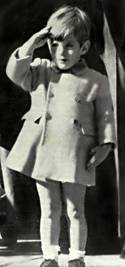
John-John Kennedy salutes his father's casket as
it passed toward Arlington. November 25, 1963.