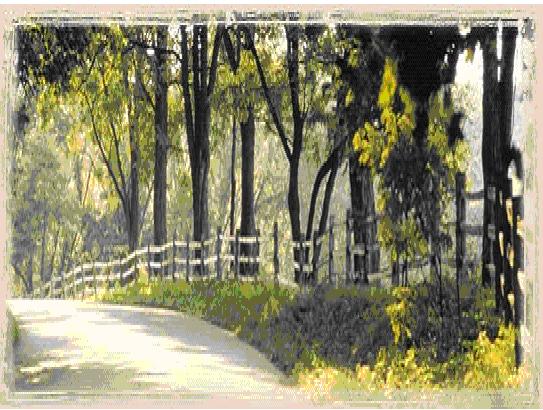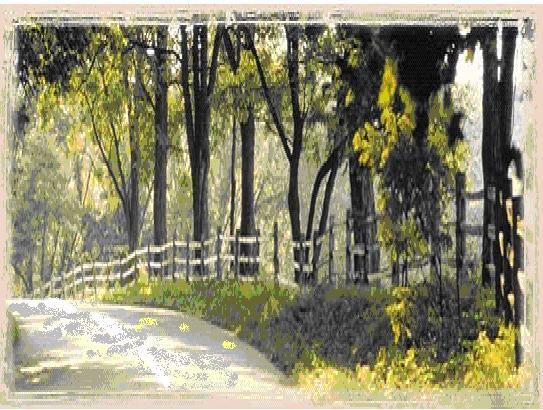
There's a road I've seen that rests between
the earth and the shade of trees,
and there he talks with the young corn stalks
that sway in the summer's breeze.
It's a lazy road who's made abode
of the hills o'r which he was laid
and stretches his spine of a white dotted line
in a cool spotted blanked of shade.
Near the end of the day when there's nothing to say
he hums to the song sparrow's tune
and watches the sun till the day is done
and then says "Good night" to the moon.
Happy Birthday, Dave and Aimee
© Copyright 1985, TK, Patterns of Ink
 Crop Circles
What if writing
of the kind I do
is but a form of madness,
senility not yet curbed

by an arthritic hand?
What if being lost in thought
is merely wandering in a maze
of corn or waist-high rye
until all my
sterile stomping there
in search of sky or light or just
a path to where I am...
shows only where I've trod
in patterns
that do not mean
a thing to man…
and little more when seen
by birds...and God?

A Front Porch Frame of Mind
had a “front porch” frame of mind,
and they’d sit out hot nights sippin’ tea—
makin’ most of a melon rind.
They knew the beckon of a breeze
that made ‘em lean back with a sigh
and say, “Maybe five more minutes…”
to some silhouettes passing by.
“Just out for a walk,” a voice responds,
“Till the house cools down a bit.”
And by and by, more friends were there
than there were places to sit.
It was natural as a cricket’s chirp
or the smell of a new-mowed lawn
to gather there like window moths
(when an inside lamp’s left on).
Just neighbors visiting neighbors
in the kindness of the night…
where differences are dimly lit
and love needs little light.
T.K. June 28, 1995 © Copyright 1995, Patterns of Ink
 I realize this poem is a bit old fashioned with a hint of Guest or Riley , but my mother loves it because it reminds her of summer nights on her front porch as a kid. It should—that’s the porch I was thinking of when I wrote it. Grandma’s front porch was nothing fancy but big enough for a glider (that sat three adults or maybe five kids) and a few chairs. Everyone else sat on the steps or sturdy railing.
 In that old turn-of-the century neighborhood, sidewalks were only about six feet from the front porches. So people passing by (on the way to Palmer Park or the little corner store) couldn't help but stop and talk. In that regard Gramma's porch was far more nostalgic and picturesque than the concrete slab porches of the little suburban ranches in Roseville, but Mom found ways to turn our front porch into the same kind of gathering place she had known.
In 1986, when my wife and I bought our first house, my parents came to share in the delight. The front porch was a tiny square (barely big enough for guests to stand aside as the door opened) enclosed by a white wrought-iron railing. One evening, Mom and I sat together on the top step with the iron hand rails at our elbows. "That's the one thing I wish this house had,” I said, “a bigger front porch." She smiled and said, "You don't have to have a front porch to have a front porch frame of mind." She had no idea those words would germinate in my thoughts for years... they're still taking root after all this time.
Think about this with me. I've never
 read or heard anything about it. * The "selling features" of houses (and neighborhoods) say a lot about human relationships and social attitudes during the time of construction. At the beginning of the 20th Century, front porches were a prominent part of houses. Porches say, “Our house is your house. Sit a while and visit.”
By the end of the 20th Century, cars became part of the family. Now homeowners are more likely to be seen standing in the open door of an attached garage than sitting on a front porch. Social space has been relocated to rear decks and patios (often with
 privacy fences). I confess, we enjoy our back patio and fire pit, and because we have no fences we do have “drop ins” on occasion, but I still think there’s a difference between gatherings in a back yard...and the spontaneous
  welcome offered to passers by on a front porch. "Good times” heard but not seen are less inviting than the irresistible neighborly greeting, gathering, and conversation on a front porch near a sidewalk.
Now factor in the unintended consequence of air conditioning. My grandma’s house had no AC; my house in Roseville had no AC; the house we built on the property was built without AC. Before air conditioning, hot nights drove people outdoors for walks or to their front porches to sit and hope for a breeze. There they were… outside where the night air is a slight improvement over the still air inside… sipping a glass of iced tea, slurping a slice of watermelon, etc. when someone from down the street strolls by and strikes up a conversation. The porch was a place to get acquainted (or “caught up”), to introduce the kids (and grandkids), and to share life—no invitation needed—all
 because it was a hot night and no one had AC. Once "air" came along, our front doors shut, the screen windows closed, and a part of us closed off to each other.
When I was a kid spending time at my gramma’s in the summer, I actually slept through the night out on the glider on the front porch—until the night I woke up and some strange dark shadow of a man was standing on the sidewalk looking at me. It was about 1:00 or 2:00AM “You okay?” he mumbled. I sat up rubbing my eyes. “Yea, I’m fine. I’m just out here because it’s hot inside.” "You got that right; it’s a hot night.” he slurred, and he staggered on his way. From then on, I slept inside with a cool damp washcloth on my forehead.
Other than experiences like that (or with persistent salesmen or proselytizers), front porches are a place for wonderful interaction. (Case in point: I dare say more innocent “first kisses” (the kind that say, “I like you” n
 ot “I want you”) have happened on a front porch than anywhere else. In fact, that’s not a bad rule-of-thumb for young dating couples who want to implement the simple rule I’ve given young people about affection: right person, right place; right reason; right time; All four “rights” have to be clear or the affection will have little meaning, and meaningless affection is a recipe for regret. That’s a little side note, but it does tie in to our front porch discussion—sort of.)
 But continue to think with me about front porches just a moment longer. Are you more of a back deck, privacy-fence kind of person? Or do you have a front porch frame of mind? It’s not a "right or wrong" answer. We all need a balance of both, but knowing how you lean socially may help sweep off your “front porch,” figuratively speaking. How about your family? How about your church or “small group” (a concept large churches are inclined to use
  these days)? Are passers by welcome or do they need the courage to knock on the gate of a privacy fence? Think about it.
 I'm partial, but I think outside observers to the school I oversee would say, there’s an atmosphere that’s inviting and social. The front guest counter is a hub of neighborly chatter; my office door is wide open whenever possible, and drop-ins are frequent; teachers are accessible; volunteers feel at home; the front rotunda is a gathering place for talking parents who lose track of the time (and the fact that they are illegally parked in the fire lane). The front sidewalk is full of smiles and waves.
We have a "closed campus” for
 practical reasons, but the tone of our school is welcoming and inviting. People comment on this all the time. What’s your secret? Why does the UPS man smile as he waits in line for a signature? Why do parents who no longer have kids in the school still stop by to purchase SCRIP? Why do our students' friends from other schools want to visit for lunch? Why do our professionall counterparts from other schools enjoy dropping by, teaching here, or availing us of their resources? There may be many reasons, but I’ll let you in on the main one… It's not a secret... It’s a front porch frame of mind.
 T.K.
*UPDATE: My mom made her poignant comment in the late 80's, and I first jotted the thoughts for the essay and poem in the early 90's. I mention this because while re-reading the post today I thought about the fact that I have never heard or read anything on what I consider a significant topic. So this afternoon, June18, I did a Google search with the words "front porch / community" and found three related articles I had never read. This one, provides the history, cultural significance, decline, and reappearance of American from porches--there's amazing agreement in our thoughts. (He tends to give more credit to the arrival of cars and television to the decline of the front porch. I still hold that AC is the biggest factor. We had cars and TV, but without AC, we spent evenings out on the porch and front lawn playing C.A.R.) This second article is shorter, but strongly underscores this post. It begins with this quote from a Tracy Lawrence song: "If the world had a front porch like we did back then, we'd still have our problems, but we'd all be friends." Get this... the author describes "Neo-traditional" communities that are going back to front porches: "The streets are designed to encourage walking and socializing among the neighbors. ...The neo-traditional neighborhoods have sidewalks and trees lining the streets for pedestrians. Front yards are shallow so that neighbors converse easily between the sidewalks and the front porches....The porch is a symbol of community, offering an invitation with its front steps reaching out and meeting the sidewalk, drawing passers-by to the comfortable chair or swing. The porch encourages family and neighborly communication." The third article is geared to senior citizens--I felt bad about that--but it's noteworthy just the same. So there you have it, I'm not the only one who believes a "A Front Porch Frame of Mind" can still work in the 21st Century. These timely links should encourage any readers who think Patterns is simply the nostalgic musings of a weekend writer--No, Sir! This is a cutting-edge blog! ;)
Past Perfect Prequil
so chilly there’s no need
to crack the window as I stay
inside the car to write or read
while the girls shop. I’m staring
presently at a lone seagull
that has lost either his bearing
or his taste, content to cull
the damp debris for who knows what
to eat—anything will do, I’d say,

like the smoldering cigarette butt
a man just flicked his way.
The gull sniffs it like a dog.
Oh, my! He’s got it in his bill
as if to mimic Bogart in the fog
at Casablanca. No one will
believe this! A lady passes by.
She doesn’t see the film-noir bird;
but sees me laughing, so I try
to point and MOUTH the word
“Smoking!” which merely
baffles her to look around
then back at me, still queerly
forming words without a sound.
So I roll down the window and say
“That seagull over there is smoking!”
She looks, but the gull has gone away—
"I don't see him now, but I’m not joking.
He was holding a cigarette...not in his wing...
but in his bill... it wasn’t his.…This guy—
Why would I make up such a thing?”
I stammer. She walks on without reply,
and who can blame her really?
It feels more like March than May.
It’s a damp cold, wet and chilly.
It’s a drizzle of sky and gray.
TK May 12, 2006
.
It's been raining for two days now. Tomorrow is supposed to do the same. It's good writing weather. A friend has observed that I tend to draw more from the past than the present. It’s true that when I reflect on "family," for instance, it's usually a backward glance with plenty of years acting as a buffer. I often go all the way back to my own childhood (or stories from my parents). That way those who share the experience are more likely honored than embarrassed (as my daughters would be if I wrote about our day-to-day shared life—someday maybe... but not now). Some stories can be told right away; others take years to crystallize into something that can be passed along without breaking.
So today I decided to write the above piece very much in the present and, in fact, in present tense. Until now, I missed the double meaning of to those two words. Not only is the present sometimes tense, but its progressive element feels more like on-the-spot reporting with a hand-held recorder than typical writing. If I ever do this again, I'll try not to involve myself in what's happening (since it’s hard to scribble in "real time" while making a fool of myself with perfect strangers).
Because I began writing this in a parked car, I really should tell you a little bit about my Grandpa S. (I know, I know…so much for the present....
He's in the front row here.)
Past Perfect
I first learned to sit in idle cars
by waiting in tavern parking lots
for Grampa. Looking back on it now,
I’m surprised it was somehow
acceptable to stop for a drink
before a road trip (or at the other end),
but that was the case with Grampa.
I say this not to judge or to offend.
(It’s just ironic that at the dawn
of industry-required seat belts,
stopping for a drink to make the drive
with four grandkids more bearable
was not yet a concern.)
Sometimes, if the wait was getting long,
Grandma would send me inside
to get him, and he always introduced me
to the bar tender with pride.
I must say in all those years
I never saw him in the grip of drink—
but I don't think I was looking.
Grampa had Humphrey Bogart's style 
when he held a cigarette—
which was almost always.
(Bogart died of cancer in '57; Grampa in '75)
Truth be told, most evenings also found
an open brown bottle near his feet,
but we loved Grampa just the same
in spite of his ways—
especially, it seems, on summer days
when the willow wept clear to the ground.
Like that wonderful night,
he sat on the back porch swing
carving little flutes of willow bark,
and we played them on the grassy slope
between the sidewalk and the house till dark.
At the end of such visits,
I'd kiss his stubbled cheek and smell the scent
of Old Spice, Lucky Strikes, and Black Label—
all part of his film noir charm.
He'd smile and say, "Be a good bad boy,"
and loved the fact that I never quite knew
what he meant. It was Grampa who
also quipped, "It'sa damp cold day,"
(which my siblings and I still cannot say
without smiling). He would have said it
today, no doubt, had he been with me
when that lone seagull vanished
like a ghost.
(C) TK May 12, 2006
On Having No Regrets
Looking back on fifty years,I can say I’ve no regrets,
which is not to say that,
if it were possible,
I’d do it all the same again
or chart the very course
for those who take my lead.
To relive life as if rehearsed
would be dismissing both
reason and recollection,
but a life with no regrets requires
neither amnesia nor perfection.
It is wise to strive for few mistakes,
embarrassments, hurts, and shame,
and never to presume on Grace…
but it would be regrettable in deed—
to never have felt pain or loss
else how would we know their cause?
Saying I’ve no regrets doesn’t mean
I’ve never blown it or needed
to say ‘I’m sorry’ or pleaded
for forgiveness.
I’ve fallen countless times.
But it would be most regrettable
to never know remorse
and the taste of swallowed pride,
and the touch of the hand that helps me up.
Having no regrets does not mean
I’ve never prayed for things
that weren’t meant to be
or for some things to somehow be undone.
But how regrettable life would be if
our needs were narrowed to what’s known,
and all our wants were within reach,
or if time remained within our grasp.
I fear we’d never learn
the patience in a promise kept,
the prudence from the tears we’ve wept.
‘Twould be hilted arrogance
to boast of no regrets as if to have
mastered life’s gauntlets—devilish or divine—
when the opposite is true.
But in the end, there’s only one regret
that cannot turn for what is best,
and that is this: to never see,
to never understand,
how regrettable life would be
if it were truly in my hand.
.
© Copyright 2006, TK, May 7, 2006, Patterns of Ink
.
There is a part of human nature that resists accountability (to man and ultimately to God); a part of us (or of mankind) that foolishly pretends that we are the master of our fate, as Henley scoffed in his poem, Invictus; a part of us resonates with Frank Sinatra's swansong, "My Way." (I suppose, if that song were speaking only of originality or of one's determination to avoid following the crowd it would be fine; but as a mortal declaration of moral independence (as the last stanza implies), it's a regrettable final bow.) There's another song that picks up this theme from a more poetic but less convincing character perspective.
When my brother Dave and I were in high school (and trying to add meat to our bones by lifting weights in the basement), we always listened to our other brother Paul's stereo albums. Our favorites were Simon and Garfunkel. I still know most of them by heart. One of them attempts to prescribe a life of no regret through resolve and retreat.
"I have my books
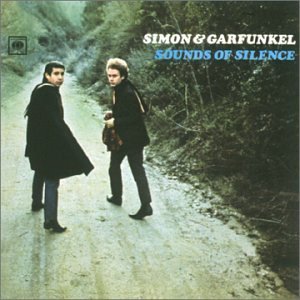
And my poetry to protect me;
I am shielded in my armor,
The Ivy on the Path
 I just stepped in from checking
on the empty house next door.
Our neighbors of four years
have moved away.
Whispering last goodbyes,
they asked if I would keep an eye
on pipes and pumps and such
that cause men’s minds to fret
when houses are alone,
and so I did just now.
There was a hollow echo
as I walked the wooden floors,
a hollow ache in knowing
that they’re gone.
Three years ago, you see,
our house began to lean their way.
I wish I were speaking figuratively,
but it literally settled a tad in their direction
and as God would have it, so did we.
That year they learned their son
(not yet the age of three) had one
of the many forms of leukemia.
Soon began the long hospital stays,
lost hair, sad eyes and sullen days.
Ours became a second home
to their other young children
left to wait and wonder
through long nights and passing play.
It was our joy to have them
through the cycles of hope and care
and returning tufts of tasseled hair
until his happy eyes rejoined our own.
And just when all seemed slightly well
for them, the tables turned for us.
On an icy afternoon
in a sterile but uncertain room
we watched things go from good
to bad and bad to worse
until the eyes of a tender nurse
foreshadowed what we later learned
from a doctor's diagram—
"single bypass best option"—which turned
out to be a twist of providence:
‘Twould be our neighbor’s gifted hand
to ply the scalpel, saw and suture
for a window to Julie's beating heart;
and when all was finally done,
‘twas he (in sweat-soaked scrubs) who told
us how it went and what things meant
and what the days ahead would hold
but not to worry after all,
since he was just a house away.
So it was... through faith and fears
and a fleeting blur of shortened years
we learned what it meant to be neighbors—
reaching out and drawing in
and reaching out once more,
'til life was gently tangled…
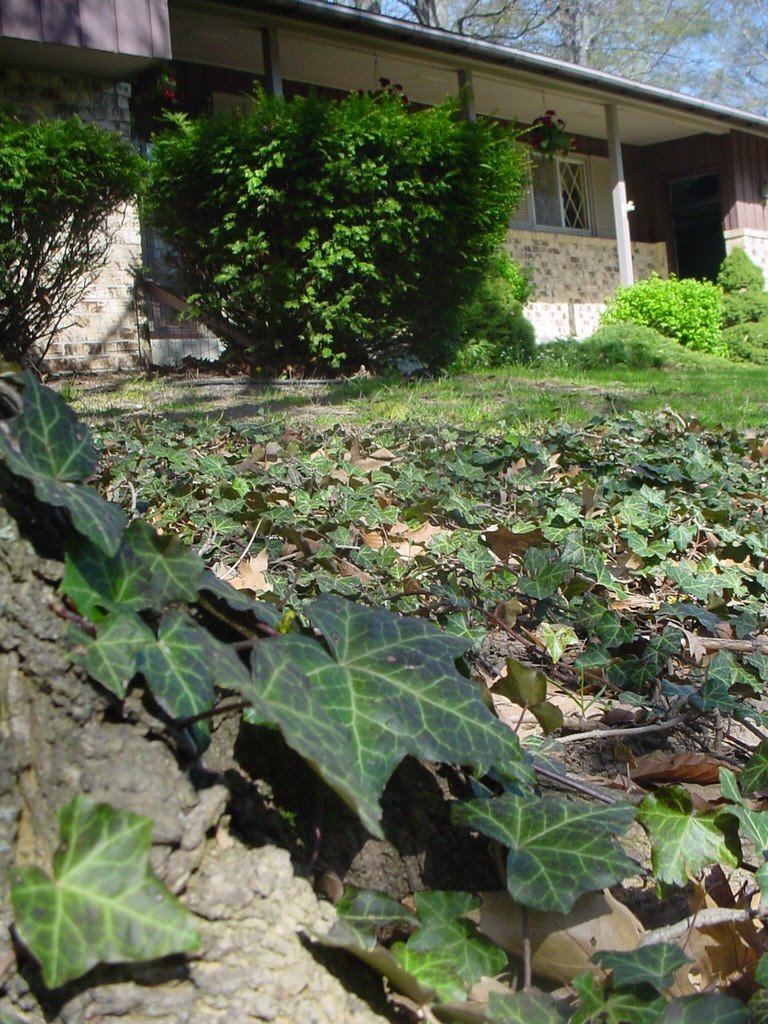
like the ivy on the path between our doors.
(C) TK April 23, 2007
Our neighbor Ike was called to another team of physicians in Idaho. He went there ahead of his family two months ago to begin work and find a house. He returned last week to finish the move and return with his wife and four children. The moving van pulled away early yesterday afternoon, and the yards seem strangely quiet. Our kids really did wear a path in the ivy between the houses. We'll see if it grows in.
Bookmarks
(in search of something else)
I came upon a book I’d left half-read
some summer past.
A memoir of a life it was
that evidently held less interest than my own
once the clock began again.
In truth it seemed not long ago,
and though I do not know
whether I passed time
or time passed me,
dust is a kind reminder
that some things settle on their own.
And as I brushed away the proof,
my finger caught the corner of a bookmark,
a photograph I must have used
to hold my place
those many years ago.
How strange to find it there—
a snapshot I’d forgotten
of a memory all but lost
until…
I took the bookmark in my hand
and, happily, it took me back
and made me laugh again.
.
© Copyright 2007, TK, Patterns of Ink
I wrote the above lines a few years ago, and while I can't imagine them being sung on New Year's Eve, they may just be the closest thing I'll ever write to Robert Burns' "Auld Lang Syne." We all know the song. Guy Lombardo and his Royal Canadians played it once a year, but I know it best from "It's a Wonderful Life" (Last scene: front room full of friends, laundry basket full of gratitude--and everyone knowing the words...)
"Should auld acquaintance be forgot
And never brought to mind?
Should auld acquaintance be forgot,
And auld lang syne?
Chorus
For auld lang syne, my dear,
For auld lang syne,
We'll tak a cup o' kindness yet,
For auld lang syne."
It's a happy song with just a touch of sadness that makes me feel the way I did in college when my mom and dad and little brother called to sing "Happy Birthday" from far away.
My mom called to sing it like old times a few minutes ago. My sister called and did the same just before that. And my brothers and others called throughout the morning. A long-lost college roommate called yesterday morning. LOL. Our middle and high school threw a big surprise "Geezer" party for me at the end of the schoolday in the cafeteria--they really got me! [And later Saturday night Julie tricked me into one more surprise gathering with a dozen friends at one of our favorite restaurants. Life's good. Thanks, Julie.]
So I guess that's it. I'm now officially 50 years old. Six-hundred months as one friend pointed out. Wow... I remember most of them, but mostly I remember who I've shared them with. Many thanks to you all for cards, emails, phone calls, etc. that "took me back and made me laugh again." Here's to Zuzu's petals!
I feel like Jimmy Stewart!
Still Loved
(in a world that's likewise broken)
battered by the endless waves
like shards of glass...
until in time,
they’re
frosted smooth
amid the surf and sand...
and rescued by a seeking hand...
held tight like something treasured.
Still loved will do ‘til hope can be restored.
(c) TK Good Friday, April 14, 2006
When I was a small boy at Lighthouse Park in Port Huron (see post below), we’d swim until we shivered in the blue water—I’m not using “blue” figuratively; ask anyone who’s been there, the water is the deepest blue you’ve ever seen, hence the name of the bridge that arches to the Canadian side—anyway…
After hours of swimming in the cold waves (about the time our lips matched the water's hue), one of us would finally declare, “I’m going in,” and the others followed suit. With arms outstretched, we'd "ouch" our way across the stony mote that gathers at that shore, then scurry to our sun-soaked towels. Mom was usually sitting there to wrap us up and pat us on the rump as we fell face-down on the blanket, our teeth chattering like stacked plates on a train. When we thawed and could walk without the palsy, we’d venture north along the beach. (The other way leads straight to the St. Clair River toward the bridge.)
We walked along a seascape of small craft against a backdrop of the huge freighters in the channel of southern Lake Huron. If there were no ships, we'd study the cottages and beautiful homes whose dry sand we could not step upon. But with one foot in the water we could walk the wave-washed line my father called “public domain.” (A rule I’ve never enquired about but still rely upon when strolling beaches.) Always when we walked, our eyes scoured for shells or special stones or the sundry things that surface in the sand. And as is true of all beaches within a mile of human life, we’d sometimes come upon bits of broken glass. My brother Dave once stepped on an unseen jagged edge and the cut required several stitches. (My Aunt had the same thing happen at a reunion near Port Crescent Beach up in “the Thumb.”)
It seems like broken glass on beaches is less common since cans and plastic came along, but even back in the late 50's and early 60's, pieces of beach glass were not always dangerous. Often we’d come upon a rounded jewel with edges warn down by the sand. Sometimes it was colored (e.g. beer-bottle brown; the light green of a Coke bottle; or the white of a porcelain cup); sometimes it was clear but frosted from friction; but always such glass was a “find.” I once picked up a beautiful blue piece probably from a broken medicine bottle or a Vick’s Vaporub jar. It was smooth as driftwood but shined translucent in the sun. I held it tightly in my hand and later slipped it in the little pouch inside my swimsuit (which little boys know was made for just such treasures).
I wish I still had that piece of blue beach glass—I’d find a way to frame it with the lines above (whose form I hope suggests the roll of waves). It would remind me that we’re all broken—some in spirit; some in grief; some in body or mind; but all in the flawed sense of the fall. We’re broken in a broken world, and we sometimes hurt each other with our jagged edges. Many things in life feel shattered; some choices cannot be undone; some mean times can't be mended. But with God’s help there's hope that (in the meantime) the edges of our brokenness can be smoothed, and those willing to reach out, willing to embrace, can in their time remind us we're still loved.
.
Romans 8: 18-22... "(18) For I consider that the sufferings of this present time are not worthy to be compared with the glory which shall be revealed in us. (19) For the earnest expectation of the creation eagerly waits for the revealing of the sons of God. (20) For the creation was subjected to futility, not willingly, but because of Him who subjected it in hope; (21) because the creation itself also will be delivered from the bondage of corruption into the glorious liberty of the children of God. (22) For we know that the whole creation groans and labors with birth pangs together until now...." Still Loved: the still implies a familial love that remains to be true--"in spite of" not "because of." (i.e. "loved anyway...and always" as Christ loves us till all else is restored).
Something Completely Else
It’s like…in a way…
the time we almost talked,
and I was…we were…
fumbling for the words to say
stumbling for
something completely else
but
something completely else
was said,
and there was a hole—
not emptiness but strange—
like the hole in the heel
of a sock that no one sees,
but all day...it's there—
the kind of care
that circumstance suspends,
a warmth that chills
a cold that melts...
something completely else
and not
what I was thinking
we were thinking at all.
I somehow
missed the meaning
of the message on the wall.
© Copyright February 25, 2006 TK, Patterns of Ink
The Knock

A House in Winter's Hold
There’s a house on a hill in a woods somewhere, in a woods where no one sees
(save those who pass with a lasting stare
at its glimmer of light through the trees).
In winter it’s a shadow of black
half-hidden by trees of gray,
and an arm of smoke
gropes from its stack
and waves with a lonely sway.

Then comes a whistling winter wind.
The house shuts tight
with a shoulder pinned
against a threatening door
and waits for what’s in store.
A blizzard is coming;
windows are humming;
to the wind’s tune
the shutters are drumming.
The house is clenched in Winter’s hold—
freezing, frosting, frightening cold,
 bare tress bending to and fro
in the pageantry of snow:
sifting, blowing, drifting, growing,
Autumn’s reaped and Winter’s sowing—
sowing seeds of icy white;
snow sifts through the moonless night;
falling thick with crystal frills
 skirting ‘round the timbered hills;
lacing lace on dry leaves curled,
still clung to branches bare;
and covering softly all the world
that the house on the hill
in the woods somewhere
will ever, ever know.
© Copyright March, 1978, TK, Patterns of Ink
.
This was one of the first poems I ever wrote. (The title never seemed right but I left it all unrevised.) It was an experiment in rhythms. The setting was inspired in part by Frost's "An Old Man's Winter Night" and the knowledge that a part of my father could happily live that life... but the linew were based mostly on that fine but foreboding feeling that comes when a family is snowbound in a winter storm as we were more than once in our house on a hill deep in the woods (which, by the way, is not in the first picture. Also, our house never did get shutters, but they were part of Dad's original plan.)
0392
If Only Hatred Came. with Halted Hands (Linked sonnet is at the bottom of this post) |
Three Days Into Spring
Three days into spring.
No robin yet as harbinger to
sing
or search among the matted weeds
where the last vestige of snow recedes
toward the shady cold.
The snowman that we rolled
and laughing lofted to its height
is gone but for one sad and small stalagmite,
standing sentinel in the sun
between two branches now undone,
the fallen arms of make-shift mirth
at rest again... upon the waking earth.
© Copyright March, 2005 , TK, Patterns of Ink
A Mourning in America
June 11, 2004. The Funeral of President Ronald W. Reagan
.
"All we go down to the dust,"
his priestly friend intoned,
and the words echoed
in the stained glass silence.
Below him on the catafalque,
bound tight in stars and stripes,
was the wooden box
that throngs for days
had come to pay respect.
Outside (and all across the land)
that which tightly held our focus
waved slowly in the darkened noon,
never lower on the mast.
It, too, seemed somehow at a loss—
not knowing how to thank the man
who made it wave so proudly in his day—
and so felt all who lined the way
and watched him leave the towering spires
and pass forever
from his city shining on the hill.
Then in the West,
as if to claim the setting sun,
he came to rest upon a chosen rise
 where were whispered last goodbyes
to him who kindly bid us all farewell
those many years ago.
The full weight of his absence
first hit me when we saw the empty mount
that bore his backward boots.
It was mourning in America...
draped not so much in sorrow
but belated gratitude.
Considering that President Bush's ( POTUS 43) second term is considered by many to be a continuation of the Reagan Revolution, I thought it might be appropriate to post something I wrote back in June.
President Reagan's death on Saturday, June 4, 2004, prompted a greater response from the public than even his greatest admirers would have predicted. After all, it had been a full decade since he had written his 1994 farewell letter to the nation informing us that he had been diagnosed with Alzheimer's disease which closed: "I now begin the journey that will lead me into the sunset of my life. I know that for America there will always be a bright dawn ahead."
The years passed by with little news of his status. He and Nancy lived those years quietly in their home in California's Simi Valley. He breathed his last in the room adjoining hers, and that private moment soon triggered a week of non-stop nostalgia and personal tribute to the man most credited for the collapse of the Soviet Union's Iron Curtain and the literal tearing down of the hated Berlin Wall. For the networks and cable news channels, it became a review of the 80's, which (thanks largely to the Clinton 90's) were remembered by many as the true apex of the waning 20th Century.
Reagan's last week in the news was the first memorable state funeral since JFK's, and there were many similar elements. The most obvious difference was that Kennedy's tragic assassination left the country reeling in disbelief and grief. Reagan's funeral was a celebration of sorts, a time when long-overdue tributes were shared-in some cases by partisans who never said a kind word about the 40th president while he led the nation into his "New Beginning." These same critics mocked Reagan's traditional values, flag-waving, and his Rockwellian ad campaign that proclaimed, "It's morning in America," (and continued running after his inauguration.)
The observances began in California at the Reagan Library, then on Wednesday moved east to the Capital via Air Force One. It was on this day that the horse-drawn caisson followed the empty-saddled horse that had Reagan's own riding boots in the stirrups. Friday, the last day of scheduled events, was a drizzle of sky and gray in D.C. The official service was held in the National Cathedral. One of the speakers chosen by Nancy to deliver a eulogy was former Senator John Danforth, who is also an Episcopal clergyman (and recently appointed US Ambassador to the U.N.). I heard his portion of the service live on the radio, and this opening line "All we go down to the dust" (which may have been original or liturgical) stuck with me through the day and came back to me when the casket was last seen in the glow of the setting California sun. See the images here.